Answer: (a) \(\frac{125}{6}\); (b)(i) \(-\frac{1}{4(2x-6)^2}+\sin x+C\); (b)(ii) \(\frac{x^8}{16}+\frac{x^4}{4}+\frac12\ln x+C\).
Set up the integral carefully. For an area between two curves, integrate the upper function minus the lower function over the correct interval.
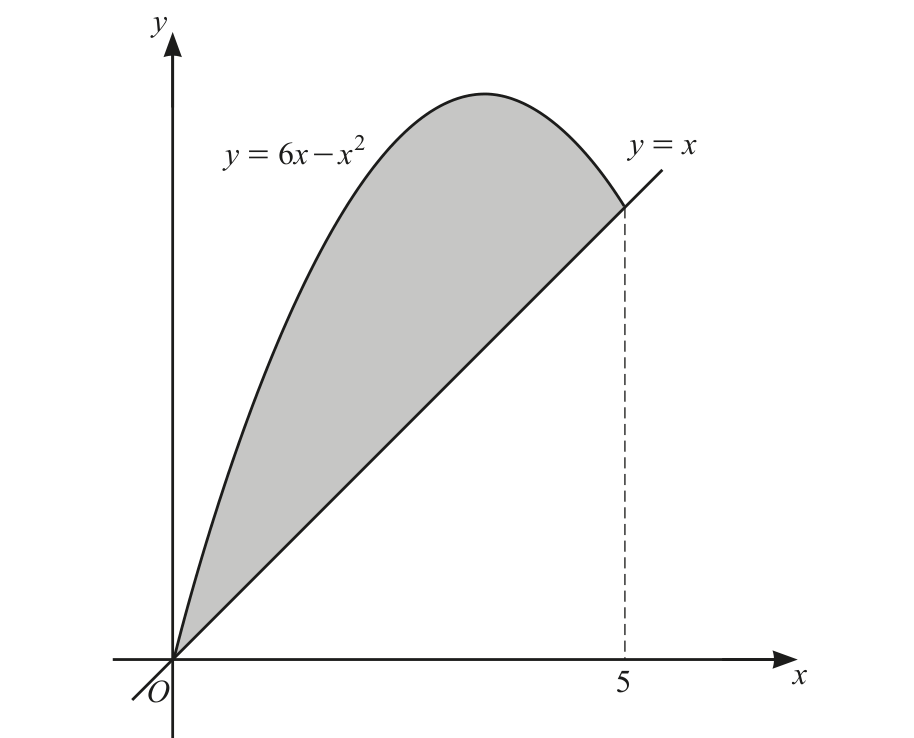
(a) The shaded region is between the curve and the line from \(x=0\) to \(x=5\). Its area is
\(\int_0^5 \bigl((6x-x^2)-x\bigr)\,dx.\)
So
\(\text{area}=\int_0^5(5x-x^2)\,dx.\)
Integrating,
\(\text{area}= \left[\frac{5x^2}{2}-\frac{x^3}{3}\right]_0^5.\)
Therefore
\(\text{area}= \frac{125}{2}-\frac{125}{3} =\frac{125}{6}.\)
(b)(i) Write the first term as \((2x-6)^{-3}\). Then
\(\int(2x-6)^{-3}\,dx =-\frac{1}{4}(2x-6)^{-2}.\)
Also
\(\int\cos x\,dx=\sin x.\)
Hence
\(\int\left(\frac{1}{(2x-6)^3}+\cos x\right)\,dx =-\frac{1}{4(2x-6)^2}+\sin x+C.\)
(b)(ii) First expand and simplify the integrand:
\(\frac{(x^4+1)^2}{2x} =\frac{x^8+2x^4+1}{2x} =\frac{x^7}{2}+x^3+\frac{1}{2x}.\)
Therefore
\(\int\frac{(x^4+1)^2}{2x}\,dx =\frac{x^8}{16}+\frac{x^4}{4}+\frac12\ln x+C.\)