0606 P13 - Jun 2023 - Q9 - 12 marks
7681
In this question lengths are in centimetres and time is in seconds.
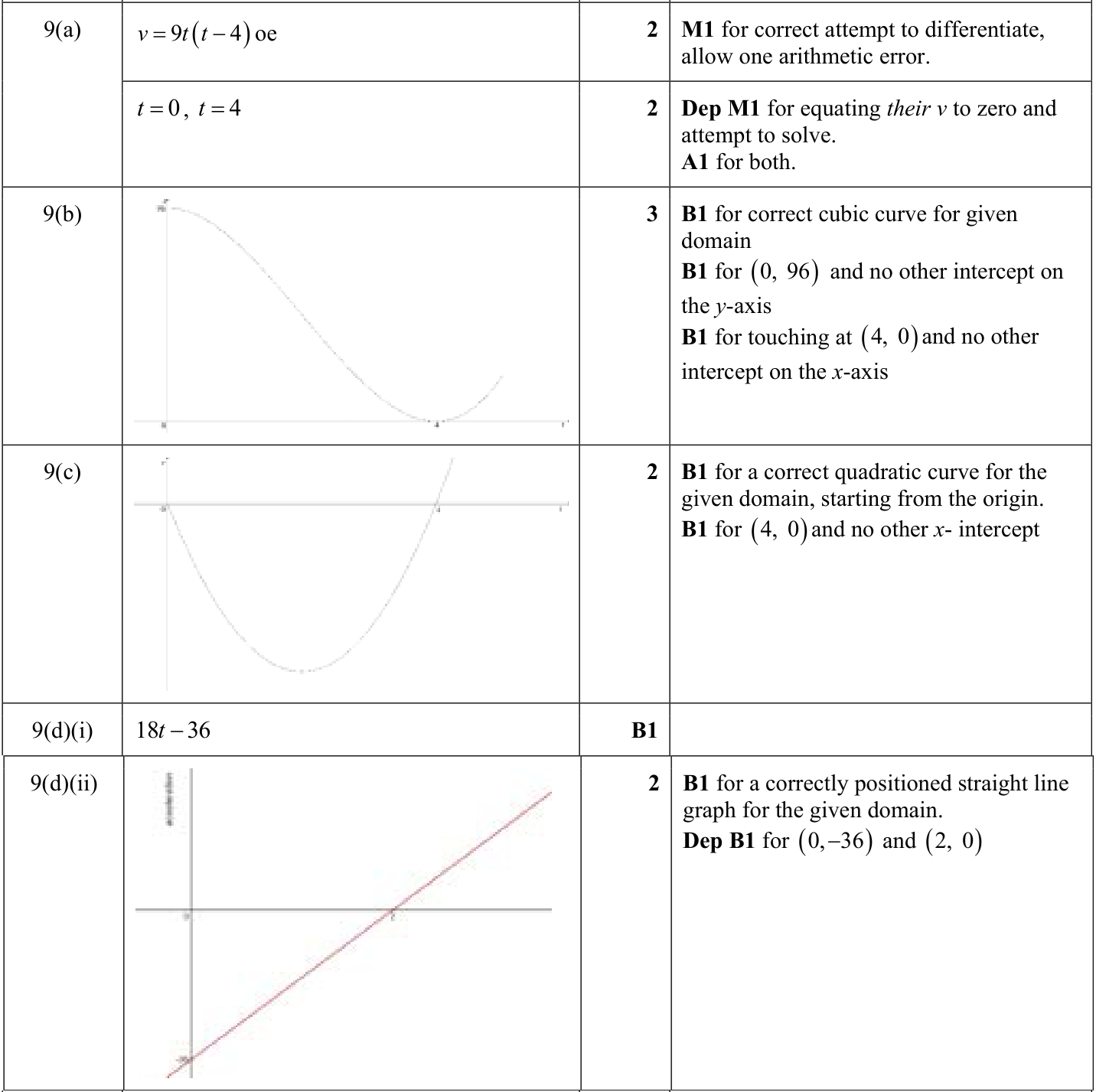
A particle \(P\) moves in a straight line such that its displacement \(s\), from a fixed point at a time \(t\), is given by
\(s=3(t+2)(t-4)^2\)
for \(0\leq t\leq5\).
(a) Find the values of \(t\) for which the velocity, \(v\), of \(P\) is zero.
(b) Sketch the displacement-time graph of \(P\), stating the intercepts with the axes.
(c) Sketch the velocity-time graph of \(P\), stating the intercepts with the axes.
(d)(i) Find an expression for the acceleration of \(P\) at time \(t\).
(d)(ii) Hence sketch the acceleration-time graph of \(P\), stating the intercepts with the axes.