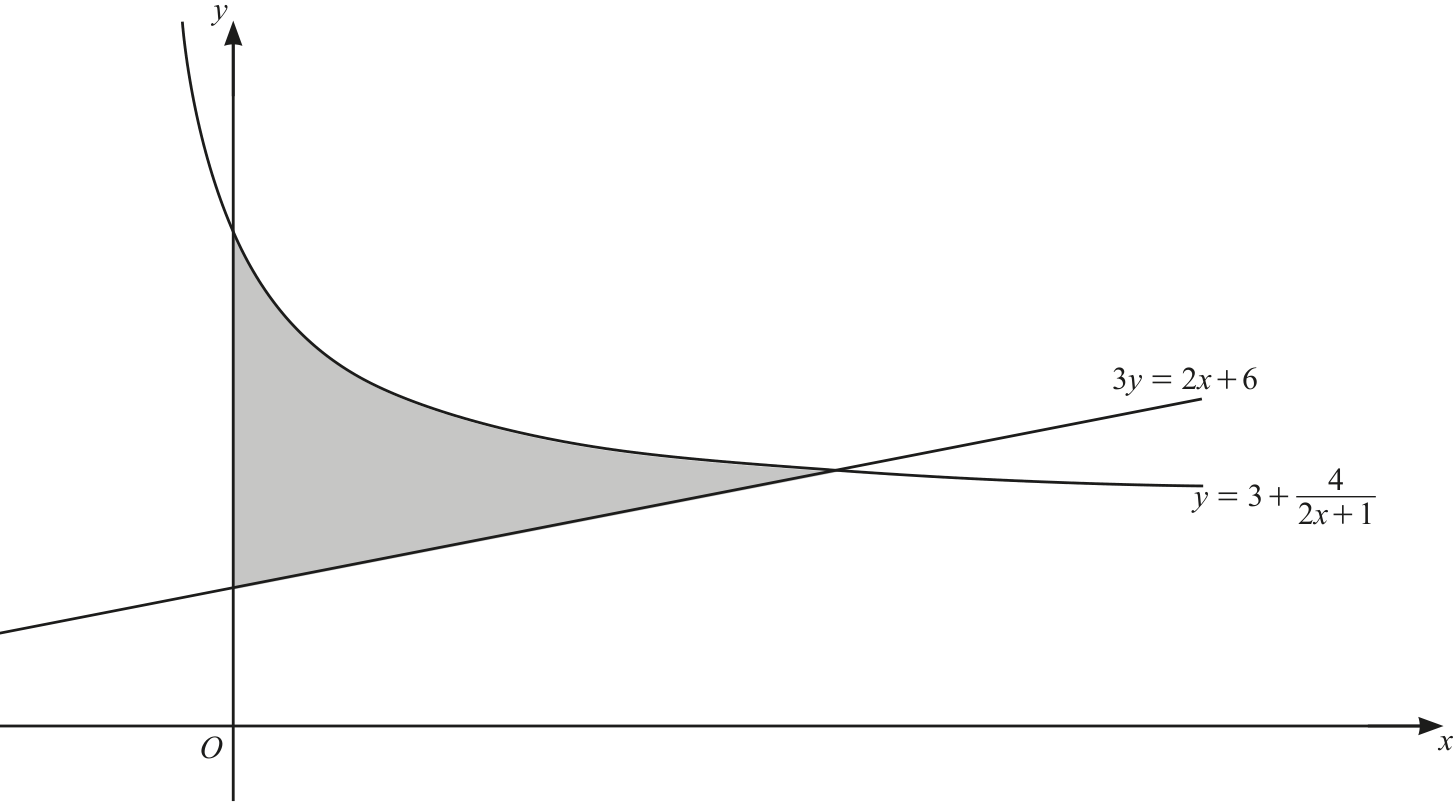
Answer: The shaded area is \(2\ln6+\frac{5}{12}\).
Set up the integral carefully. For an area between two curves, integrate the upper function minus the lower function over the correct interval.
The point of intersection of the line and the curve is found by solving
\(\frac{2x+6}{3}=3+\frac4{2x+1}.\)
Multiplying out gives
\(4x^2-4x-15=0.\)
Factorising, or using the quadratic formula, gives
\(x=\frac52 \quad\text{or}\quad x=-\frac32.\)
For the shaded region shown, the relevant intersection is
\(x=\frac52.\)
On \(0\leq x\leq\frac52\), the curve lies above the line. Therefore the shaded area is
\(\int_0^{5/2}\left(3+\frac4{2x+1}-\frac{2x+6}{3}\right)\,\mathrm dx.\)
Simplify the integrand:
\(3+\frac4{2x+1}-\frac{2x+6}{3} =1+\frac4{2x+1}-\frac{2x}{3}.\)
So the area is
\(\int_0^{5/2}\left(1+\frac4{2x+1}-\frac{2x}{3}\right)\,\mathrm dx.\)
Integrating gives
\(\left[x+2\ln(2x+1)-\frac{x^2}{3}\right]_0^{5/2}.\)
Substitute the limits:
\(\frac52+2\ln6-\frac{25}{12}.\)
Hence
\(\text{area}=2\ln6+\frac5{12}.\)