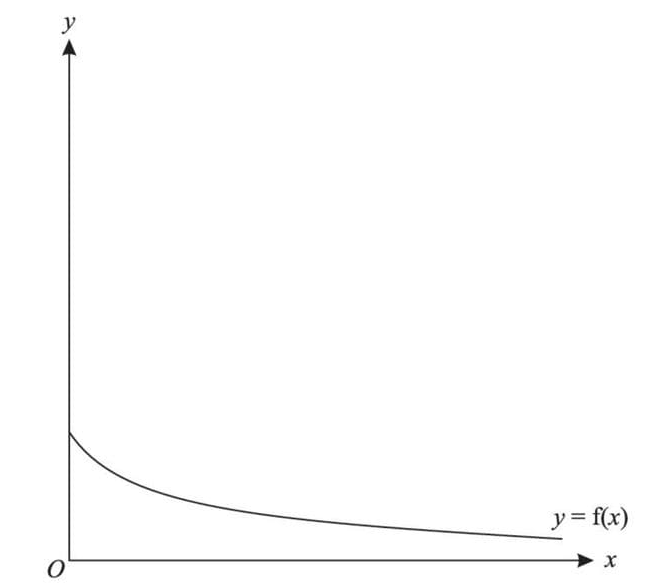
The diagram shows the graph of \(y = f(x)\), where \(f : x \mapsto \frac{6}{2x+3}\) for \(x \geq 0\).
(ii) Find an expression, in terms of \(x\), for \(f^{-1}(x)\) and find the domain of \(f^{-1}\).
(iii) Copy the diagram and, on your copy, sketch the graph of \(y = f^{-1}(x)\), making clear the relationship between the graphs.
The function \(g\) is defined by \(g : x \mapsto \frac{1}{2}x\) for \(x \geq 0\).
(iv) Solve the equation \(fg(x) = \frac{3}{2}\).
Solution
(ii) Start with \(y = \frac{6}{2x+3}\). To find \(f^{-1}(x)\), interchange \(x\) and \(y\):
\(x = \frac{6}{2y+3}\)
Solve for \(y\):
\(x(2y+3) = 6\)
\(2xy + 3x = 6\)
\(2xy = 6 - 3x\)
\(y = \frac{6 - 3x}{2x}\)
\(f^{-1}(x) = \frac{1}{2}(\frac{6}{x} - 3)\)
The domain of \(f^{-1}\) is \(0 < x \leq 2\) because \(f(x)\) is defined for \(x \geq 0\) and \(f(x) \to 0\) as \(x \to \infty\).
(iii) The graph of \(y = f^{-1}(x)\) is a reflection of \(y = f(x)\) across the line \(y = x\).
(iv) Given \(fg(x) = \frac{3}{2}\), substitute \(g(x) = \frac{1}{2}x\):
\(f\left(\frac{1}{2}x\right) = \frac{3}{2}\)
\(\frac{6}{2\left(\frac{1}{2}x\right) + 3} = \frac{3}{2}\)
\(\frac{6}{x + 3} = \frac{3}{2}\)
Cross-multiply:
\(12 = 3(x + 3)\)
\(12 = 3x + 9\)
\(3 = 3x\)
\(x = 1\)
Log in to record attempts.