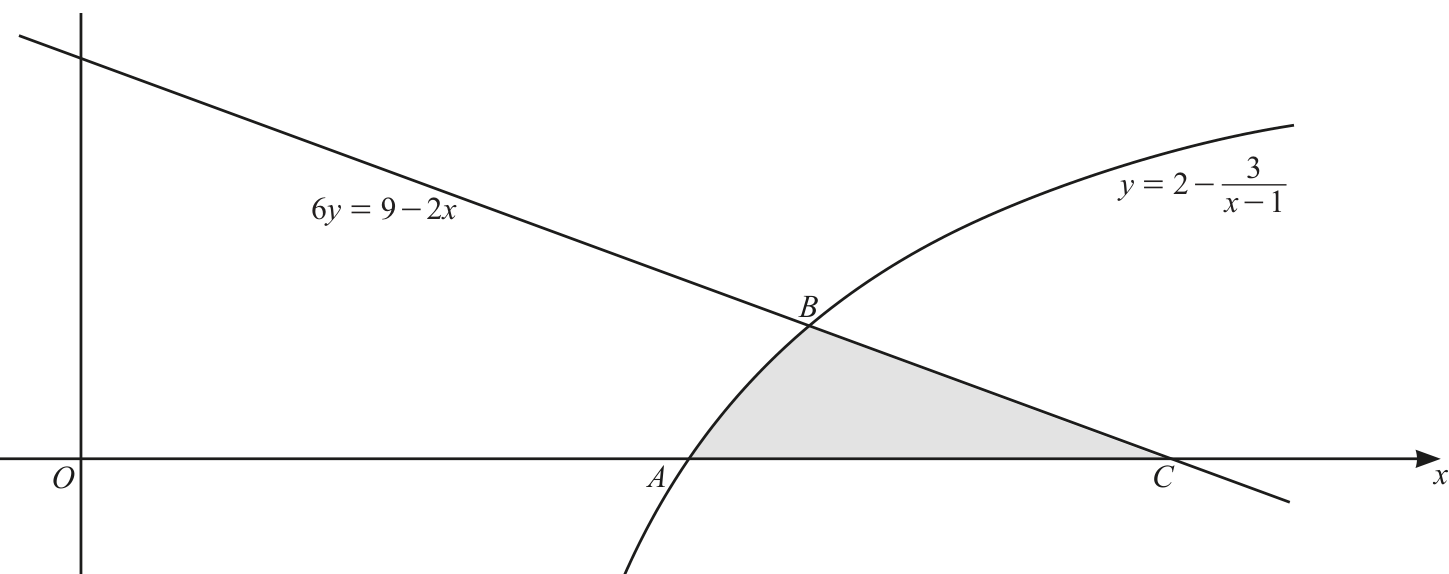
Answer: \(\displaystyle \frac{11}{8}+\ln\frac{27}{64}\).
Set up the integral carefully. For an area between two curves, integrate the upper function minus the lower function over the correct interval.
The curve is
\(y=2-\frac{3}{x-1}.\)
At the \(x\)-axis, \(y=0\), so
\(0=2-\frac{3}{x-1}.\)
Hence
\(\frac{3}{x-1}=2,\)
so
\(x-1=\frac32.\)
Therefore
\(A=\left(\frac52,0\right).\)
The line is
\(6y=9-2x,\)
so
\(y=\frac32-\frac{x}{3}.\)
At the \(x\)-axis,
\(0=\frac32-\frac{x}{3},\)
which gives
\(C=\left(\frac92,0\right).\)
To find \(B\), solve
\(2-\frac{3}{x-1}=\frac32-\frac{x}{3}.\)
Multiplying by \(6(x-1)\),
\(12(x-1)-18=(9-2x)(x-1).\)
This simplifies to
\(2x^2+x-21=0.\)
Thus
\((2x+7)(x-3)=0.\)
The intersection in the shaded region is
\(x=3.\)
Then
\(y=\frac32-\frac{3}{3}=\frac12.\)
So
\(B=\left(3,\frac12\right).\)
The shaded area is the area under the curve from \(x=\frac52\) to \(x=3\), plus the area under the line from \(x=3\) to \(x=\frac92\).
For the curve,
\(\int\left(2-\frac{3}{x-1}\right)\,dx =2x-3\ln(x-1).\)
So
\(\int_{5/2}^{3}\left(2-\frac{3}{x-1}\right)\,dx =\left[2x-3\ln(x-1)\right]_{5/2}^{3}.\)
This gives
\((6-3\ln2)-\left(5-3\ln\frac32\right) =1+3\ln\frac34.\)
For the line,
\(\int_3^{9/2}\left(\frac32-\frac{x}{3}\right)\,dx =\left[\frac{3x}{2}-\frac{x^2}{6}\right]_3^{9/2}.\)
This equals
\(\frac38.\)
Therefore the shaded area is
\(1+\frac38+3\ln\frac34.\)
Hence
\(\text{Area}=\frac{11}{8}+\ln\left(\frac34\right)^3 =\frac{11}{8}+\ln\frac{27}{64}.\)