9709 P11 - Nov 2011 - Q11
765
Functions f and g are defined by
\(f : x \mapsto 2x^2 - 8x + 10\) for \(0 \leq x \leq 2\),
\(g : x \mapsto x\) for \(0 \leq x \leq 10\).
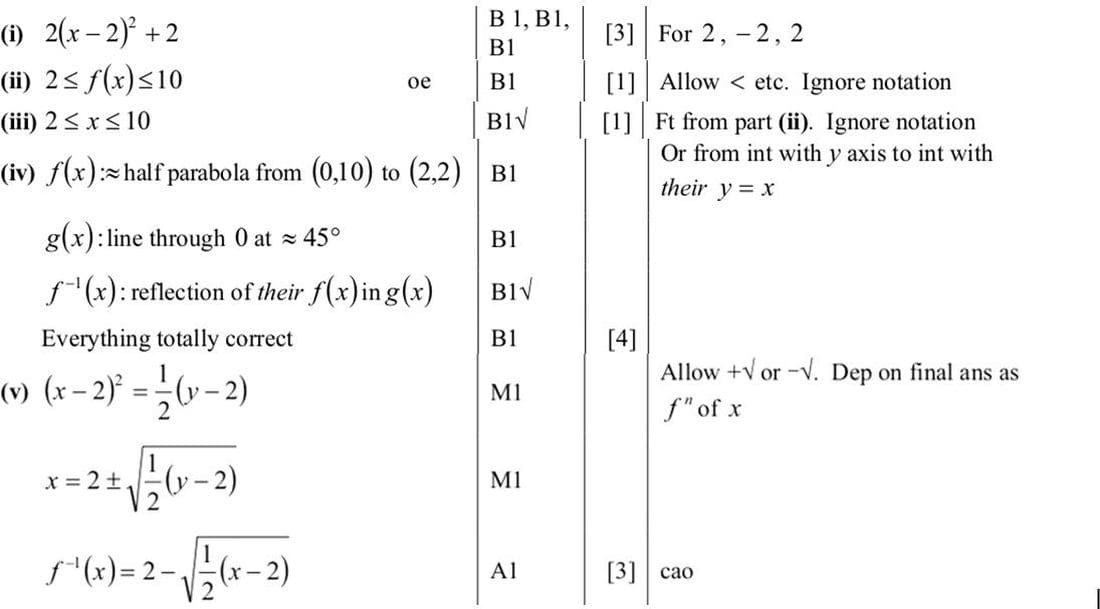
- Express \(f(x)\) in the form \(a(x + b)^2 + c\), where \(a, b\) and \(c\) are constants.
- State the range of \(f\).
- State the domain of \(f^{-1}\).
- Sketch on the same diagram the graphs of \(y = f(x)\), \(y = g(x)\) and \(y = f^{-1}(x)\), making clear the relationship between the graphs.
- Find an expression for \(f^{-1}(x)\).