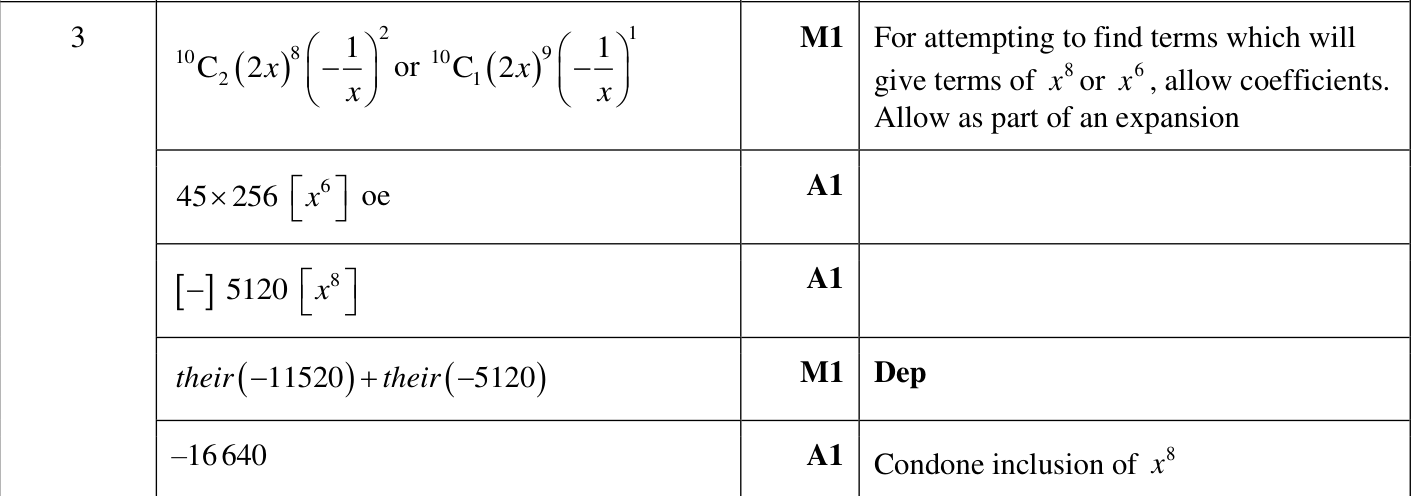
Answer: \(-16640\).
Use the binomial theorem carefully, keeping track of the power of each factor in the general term.
The general term in the expansion of
\(\left(2x-\frac1x\right)^{10}\)
is
\(\binom{10}{r}(2x)^{10-r}\left(-\frac1x\right)^r.\)
This simplifies to
\(\binom{10}{r}2^{10-r}(-1)^r x^{10-2r}.\)
Now
\((1-x^2)\left(2x-\frac1x\right)^{10} =\left(2x-\frac1x\right)^{10} -x^2\left(2x-\frac1x\right)^{10}.\)
To get \(x^8\) from the first part, we need
\(10-2r=8,\)
so \(r=1\). The coefficient is
\(\binom{10}{1}2^9(-1)=-5120.\)
To get \(x^8\) from
\(-x^2\left(2x-\frac1x\right)^{10},\)
we need the coefficient of \(x^6\) in the expansion. This occurs when
\(10-2r=6,\)
so \(r=2\). The coefficient of \(x^6\) is
\(\binom{10}{2}2^8=45\cdot256=11520.\)
Because this term is multiplied by \(-x^2\), its contribution to the \(x^8\) coefficient is
\(-11520.\)
Therefore the coefficient of \(x^8\) is
\(-5120-11520=-16640.\)