A function \(f\) is defined by \(f : x \mapsto 4 - 5x\) for \(x \in \mathbb{R}\).
(i) Find an expression for \(f^{-1}(x)\) and find the point of intersection of the graphs of \(y = f(x)\) and \(y = f^{-1}(x)\).
(ii) Sketch, on the same diagram, the graphs of \(y = f(x)\) and \(y = f^{-1}(x)\), making clear the relationship between the graphs.
Solution
(i) To find the inverse function \(f^{-1}(x)\), start with \(y = 4 - 5x\).
Solve for \(x\):
\(y = 4 - 5x\)
\(5x = 4 - y\)
\(x = \frac{4-y}{5}\)
Thus, \(f^{-1}(x) = \frac{4-x}{5}\).
To find the intersection, set \(f(x) = f^{-1}(x)\):
\(4 - 5x = \frac{4-x}{5}\)
Multiply through by 5:
\(20 - 25x = 4 - x\)
\(20 - 4 = 25x - x\)
\(16 = 24x\)
\(x = \frac{2}{3}\)
Substitute back to find \(y\):
\(y = 4 - 5 \left( \frac{2}{3} \right) = \frac{2}{3}\)
So, the point of intersection is \(\left( \frac{2}{3}, \frac{2}{3} \right)\).
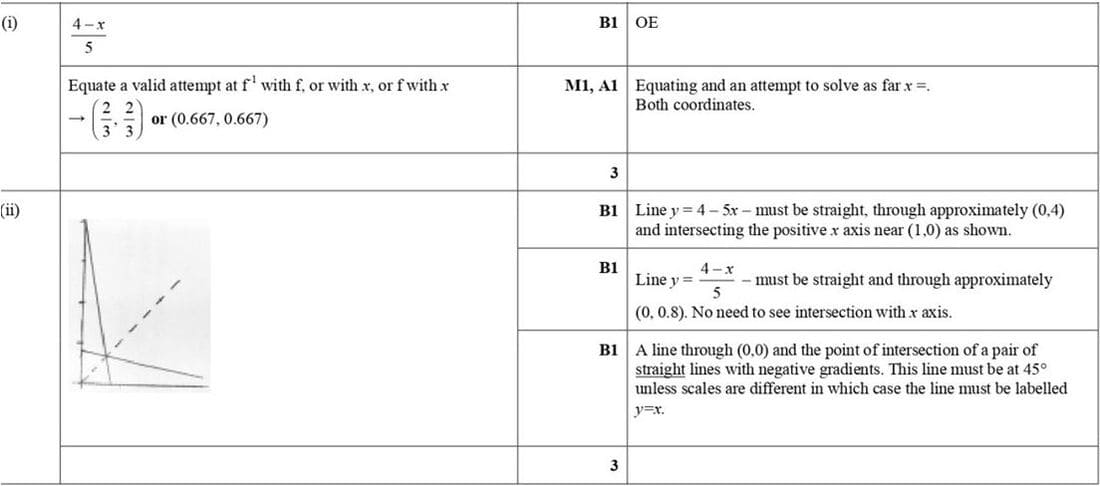
(ii) The graph of \(y = f(x) = 4 - 5x\) is a straight line with a negative slope, intersecting the y-axis at 4.
The graph of \(y = f^{-1}(x) = \frac{4-x}{5}\) is also a straight line with a negative slope, intersecting the y-axis at \(\frac{4}{5}\).
The line \(y = x\) is the line of symmetry between the function and its inverse.
Log in to record attempts.