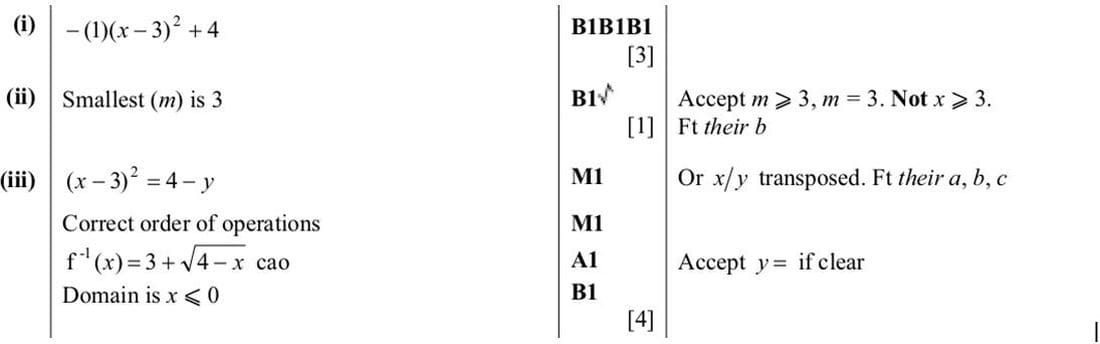
(i) To express \(-x^2 + 6x - 5\) in the form \(a(x + b)^2 + c\), we complete the square:
\(-x^2 + 6x - 5 = -1(x^2 - 6x) - 5\)
Complete the square for \(x^2 - 6x\):
\(x^2 - 6x = (x - 3)^2 - 9\)
Thus, \(-1(x^2 - 6x) = -1((x - 3)^2 - 9) = -1(x - 3)^2 + 9\)
Therefore, \(-x^2 + 6x - 5 = -1(x - 3)^2 + 9 - 5 = -1(x - 3)^2 + 4\)
(ii) The function \(f(x) = -x^2 + 6x - 5\) is a downward-opening parabola. It is one-one when restricted to the domain where \(x\) is greater than or equal to the vertex. The vertex is at \(x = 3\), so the smallest \(m\) is 3.
(iii) For \(m = 5\), we find the inverse:
Start with \(y = -x^2 + 6x - 5\)
Rearrange to solve for \(x\):
\(y = -(x - 3)^2 + 4\)
\((x - 3)^2 = 4 - y\)
\(x - 3 = \pm \sqrt{4 - y}\)
Since \(x \geq 3\), we take the positive root:
\(x = 3 + \sqrt{4 - y}\)
Thus, \(f^{-1}(x) = 3 + \sqrt{4 - x}\)
The domain of \(f^{-1}\) is \(x \leq 0\) because the range of \(f\) for \(x \geq 5\) is \(-\infty \leq y \leq 0\).