Answer: \(18\dfrac12+\dfrac13\ln13\).
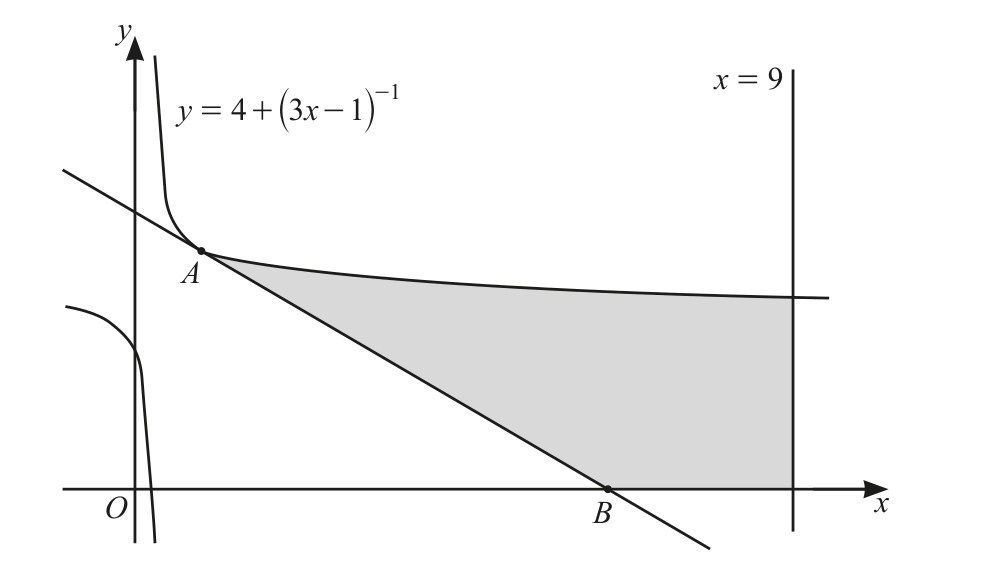
We start with the main method. Use the measurements and relationships shown in the diagram, then translate them into algebraic or trigonometric equations. Find the relevant boundary equations and use integration to subtract the lower curve from the upper curve.
The curve is
\(y=4+(3x-1)^{-1}.\)
Differentiate:
\(\frac{\mathrm dy}{\mathrm dx}=-3(3x-1)^{-2}.\)
At \(x=1\),
\(y=4+\frac{1}{2}=\frac92,\)
and
\(\frac{\mathrm dy}{\mathrm dx}=-3(2)^{-2}=-\frac34.\)
So the tangent at \(A\) is
\(y-\frac92=-\frac34(x-1).\)
To find \(B\), set \(y=0\):
\(-\frac92=-\frac34(x-1).\)
This gives \(x=7\), so \(B=(7,0)\).
The triangular part under the tangent from \(x=1\) to \(x=7\) has area
\(\frac12\cdot6\cdot\frac92=\frac{27}{2}.\)
The area under the curve from \(x=1\) to \(x=9\) is
\(\int_1^9 \left(4+\frac{1}{3x-1}\right)\,\mathrm dx.\)
An antiderivative is
\(4x+\frac13\ln(3x-1).\)
Therefore the area under the curve is
\(\left[4x+\frac13\ln(3x-1)\right]_1^9\).
This equals
\(32+\frac13\ln\frac{26}{2}=32+\frac13\ln13.\)
The required shaded area is the area under the curve minus the triangular part:
\(32+\frac13\ln13-\frac{27}{2}=18\frac12+\frac13\ln13.\)
This completes the solution and gives the required result.