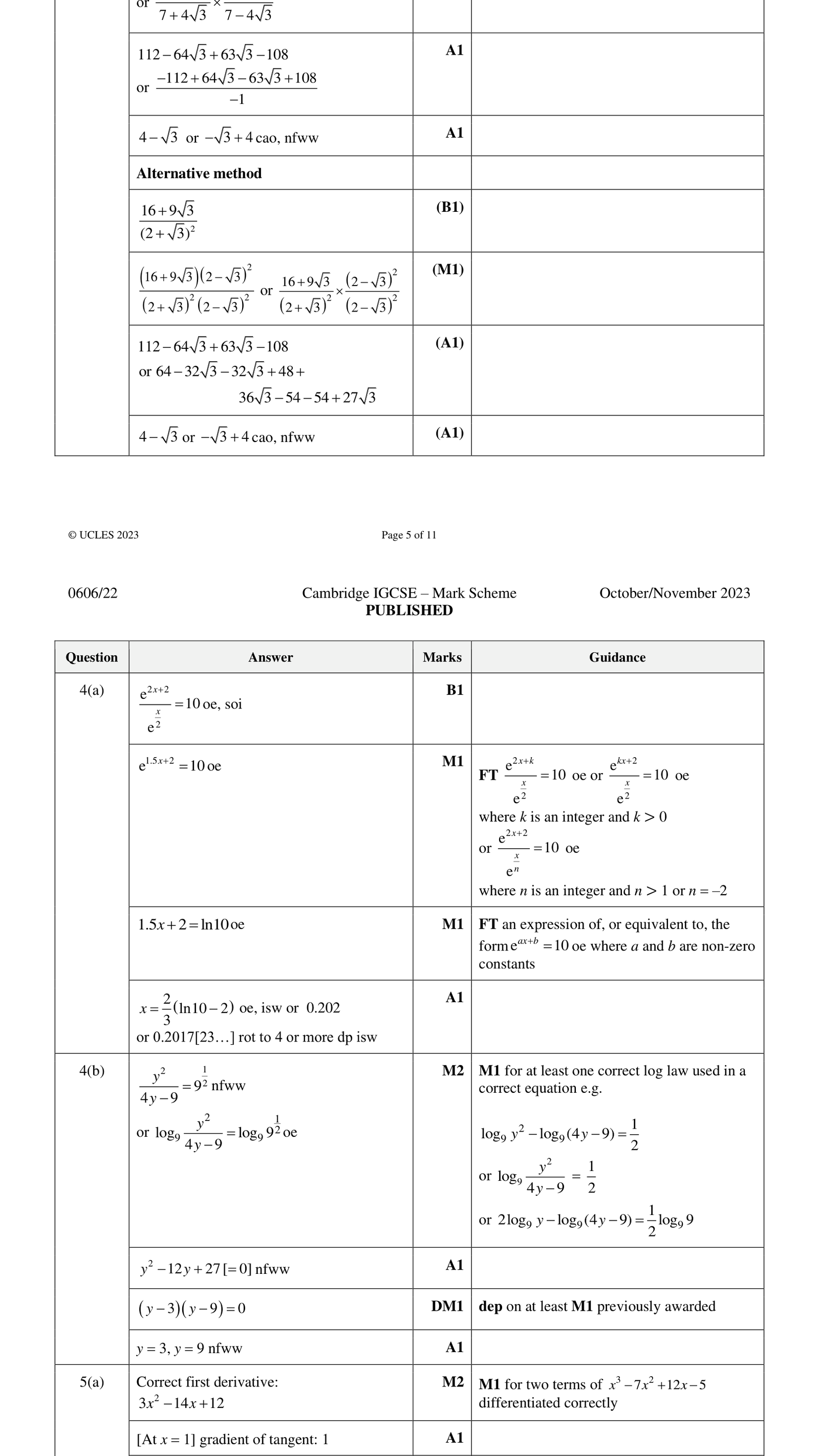
Answer: (a) \(x=\frac23(\ln10-2)\); (b) \(y=3\) or \(y=9\).
We start with the main method. Use logarithm laws and index laws first so that the equation is reduced to an algebraic equation.
(a) Use the laws of indices:
\(\frac{(\mathrm e^{x+1})^2}{\sqrt{\mathrm e^x}} =\frac{\mathrm e^{2x+2}}{\mathrm e^{x/2}}.\)
So the equation becomes
\(\mathrm e^{2x+2-x/2}=10.\)
Hence
\(\mathrm e^{\frac32x+2}=10.\)
Taking natural logarithms,
\(\frac32x+2=\ln10.\)
Therefore
\(x=\frac23(\ln10-2).\)
(b) Use \(2\log_9y=\log_9(y^2)\):
\(\log_9(y^2)-\log_9(4y-9)=\frac12.\)
So
\(\log_9\left(\frac{y^2}{4y-9}\right)=\frac12.\)
Since \(9^{1/2}=3\),
\(\frac{y^2}{4y-9}=3.\)
Thus
\(y^2=12y-27,\)
so
\(y^2-12y+27=0.\)
Factorising,
\((y-3)(y-9)=0.\)
Both values satisfy the logarithm domain conditions, so
\(y=3\quad\text{or}\quad y=9.\)
This completes the solution and gives the required result.