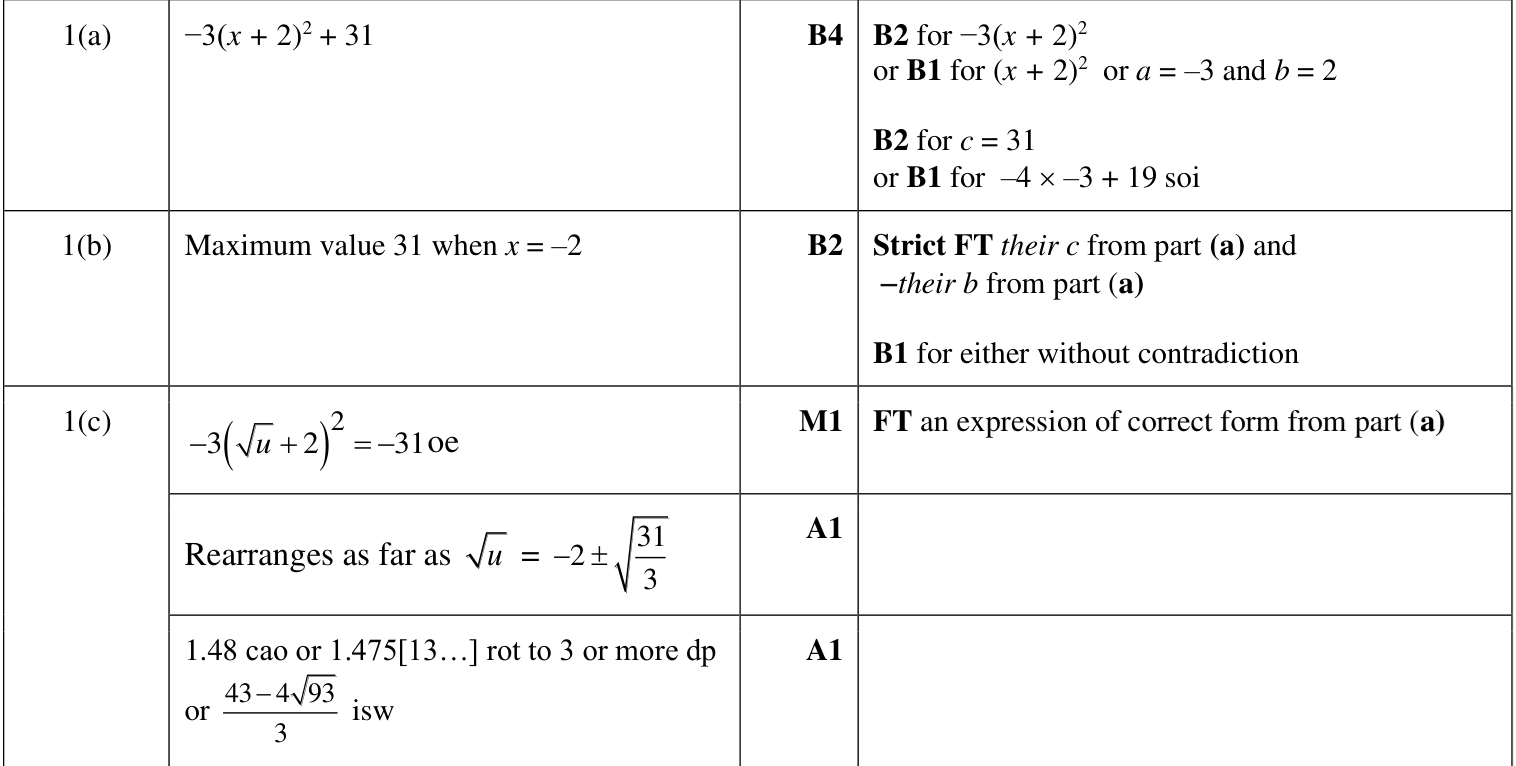
Answer: (a) \(-3(x+2)^2+31\); (b) maximum \(31\) when \(x=-2\); (c) \(u=\left(-2+\sqrt{\frac{31}{3}}\right)^2\approx1.48\).
We start with the main method. Complete the square first, because this immediately shows the turning value and the value of the variable at which it occurs.
(a) Start by factorising the quadratic terms:
\(19-12x-3x^2=-3(x^2+4x)+19.\)
Complete the square inside the bracket:
\(x^2+4x=(x+2)^2-4.\)
So
\(19-12x-3x^2=-3\big((x+2)^2-4\big)+19.\)
Hence
\(19-12x-3x^2=-3(x+2)^2+12+19.\)
Therefore
\(19-12x-3x^2=-3(x+2)^2+31.\)
(b) Since \((x+2)^2\geq0\), the term \(-3(x+2)^2\leq0\).
So the greatest possible value occurs when
\((x+2)^2=0,\)
which gives \(x=-2\).
The maximum value is then
\(31.\)
(c) Let \(x=\sqrt u\). Then \(u=x^2\), and the equation becomes
\(19-12x-3x^2=0.\)
Using part (a),
\(-3(x+2)^2+31=0.\)
So
\((x+2)^2=\frac{31}{3}.\)
Thus
\(x=-2\pm\sqrt{\frac{31}{3}}.\)
But \(x=\sqrt u\geq0\), so only the positive value is possible:
\(x=-2+\sqrt{\frac{31}{3}}.\)
Therefore
\(u=x^2=\left(-2+\sqrt{\frac{31}{3}}\right)^2.\)
Numerically,
\(u\approx1.48.\)
This completes the solution and gives the required result.