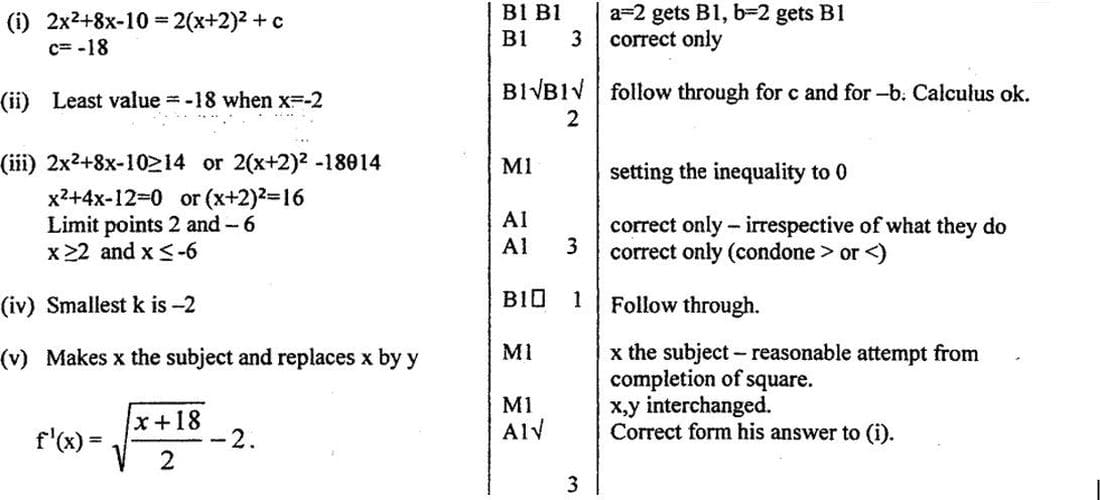
(i) To express \(2x^2 + 8x - 10\) in the form \(a(x + b)^2 + c\), complete the square:
\(2x^2 + 8x - 10 = 2(x^2 + 4x) - 10\)
\(= 2((x+2)^2 - 4) - 10\)
\(= 2(x+2)^2 - 8 - 10\)
\(= 2(x+2)^2 - 18\)
Thus, \(a = 2\), \(b = 2\), \(c = -18\).
(ii) The least value of \(y\) occurs at the vertex of the parabola, which is at \(x = -2\). Substituting \(x = -2\) into the equation:
\(y = 2(-2)^2 + 8(-2) - 10 = 8 - 16 - 10 = -18\)
Thus, the least value of \(y\) is \(-18\) when \(x = -2\).
(iii) To find the set of values of \(x\) for which \(y \geq 14\), solve:
\(2x^2 + 8x - 10 \geq 14\)
\(2x^2 + 8x - 24 \geq 0\)
\(x^2 + 4x - 12 \geq 0\)
\((x+6)(x-2) \geq 0\)
The solution is \(x \geq 2\) or \(x \leq -6\).
(iv) For \(f\) to be one-one, the domain must be restricted to where the function is either increasing or decreasing. The vertex is at \(x = -2\), so the smallest \(k\) is \(-2\).
(v) To find \(f^{-1}(x)\), solve \(y = 2x^2 + 8x - 10\) for \(x\):
\(y = 2(x+2)^2 - 18\)
\(y + 18 = 2(x+2)^2\)
\(\frac{y+18}{2} = (x+2)^2\)
\(x+2 = \pm \sqrt{\frac{y+18}{2}}\)
Since \(x \geq -2\), choose the positive root:
\(x = \sqrt{\frac{y+18}{2}} - 2\)
Thus, \(f^{-1}(x) = \sqrt{\frac{x+18}{2}} - 2\).