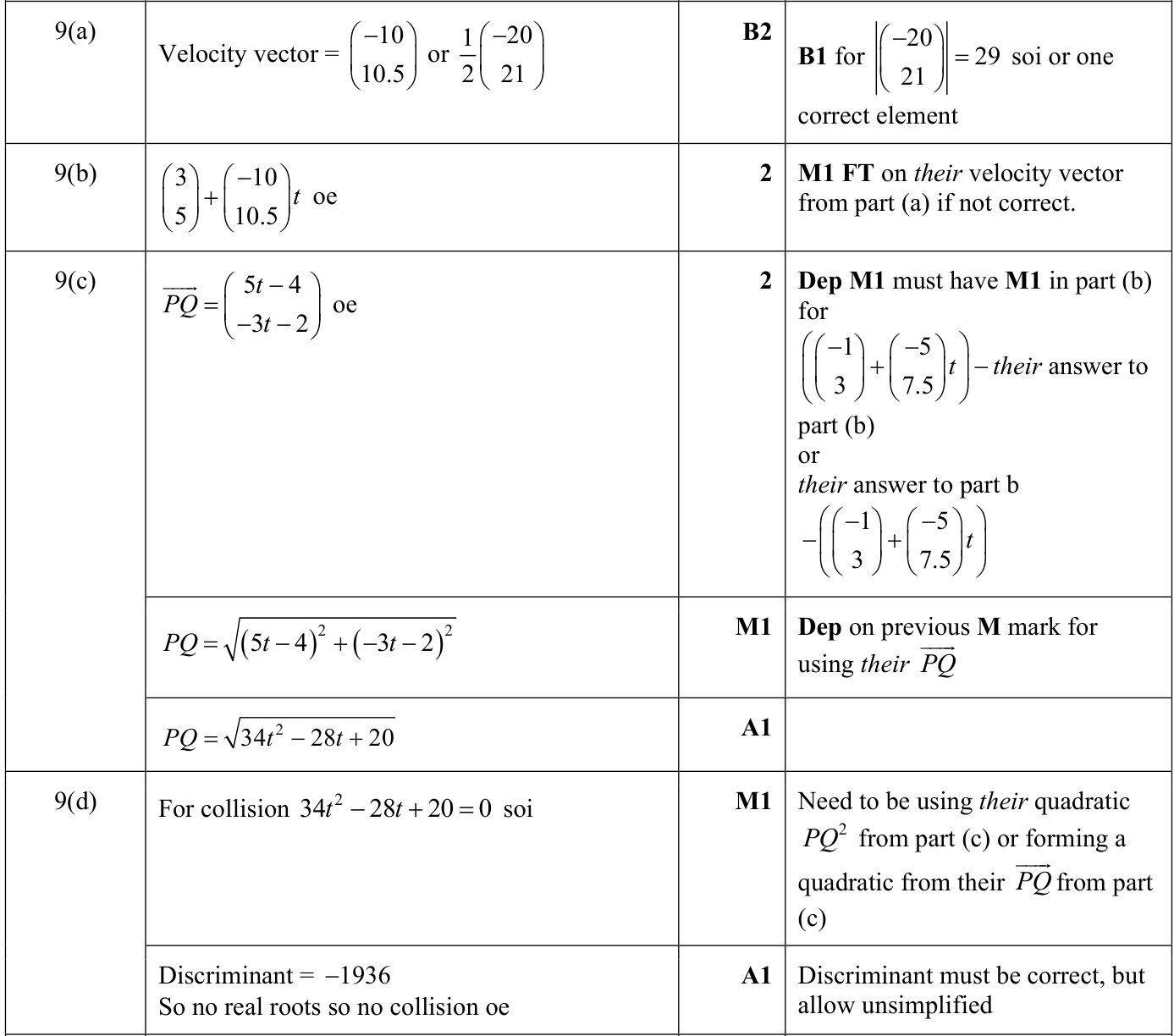
Answer: velocity \(\begin{pmatrix}-10\\10.5\end{pmatrix}\); position \(\begin{pmatrix}3\\5\end{pmatrix}+\begin{pmatrix}-10\\10.5\end{pmatrix}t\); distance \(=\sqrt{34t^2-28t+20}\); no collision.
We start with the main method. Use the constant velocity model \(s=ut\), together with any vector or component information given.
The direction vector is
\(\begin{pmatrix}-20\\21\end{pmatrix}.\)
Its magnitude is
\(\sqrt{(-20)^2+21^2}=\sqrt{400+441}=29.\)
The speed is \(14.5\), so the velocity vector is
\(\frac{14.5}{29}\begin{pmatrix}-20\\21\end{pmatrix} =\frac12\begin{pmatrix}-20\\21\end{pmatrix} =\begin{pmatrix}-10\\10.5\end{pmatrix}.\)
The initial position vector of \(P\) is \(\begin{pmatrix}3\\5\end{pmatrix}\), so its position vector at time \(t\) is
\(\begin{pmatrix}3\\5\end{pmatrix}+\begin{pmatrix}-10\\10.5\end{pmatrix}t.\)
The position vector of \(Q\) is
\(\begin{pmatrix}-1\\3\end{pmatrix}+\begin{pmatrix}-5\\7.5\end{pmatrix}t.\)
So the vector from \(P\) to \(Q\) is
\(\begin{pmatrix}-1\\3\end{pmatrix}+\begin{pmatrix}-5\\7.5\end{pmatrix}t -\left(\begin{pmatrix}3\\5\end{pmatrix}+\begin{pmatrix}-10\\10.5\end{pmatrix}t\right).\)
This simplifies to
\(\begin{pmatrix}5t-4\\-3t-2\end{pmatrix}.\)
Therefore the distance between \(P\) and \(Q\) is
\(\sqrt{(5t-4)^2+(-3t-2)^2}.\)
Expand:
\((5t-4)^2=25t^2-40t+16\)
and
\((-3t-2)^2=9t^2+12t+4.\)
Hence
\(PQ=\sqrt{34t^2-28t+20}.\)
For a collision, the distance would have to be zero, so
\(34t^2-28t+20=0.\)
The discriminant is
\((-28)^2-4(34)(20)=784-2720=-1936.\)
Since the discriminant is negative, this quadratic has no real roots.
Therefore \(P\) and \(Q\) never collide.
This completes the solution and gives the required result.