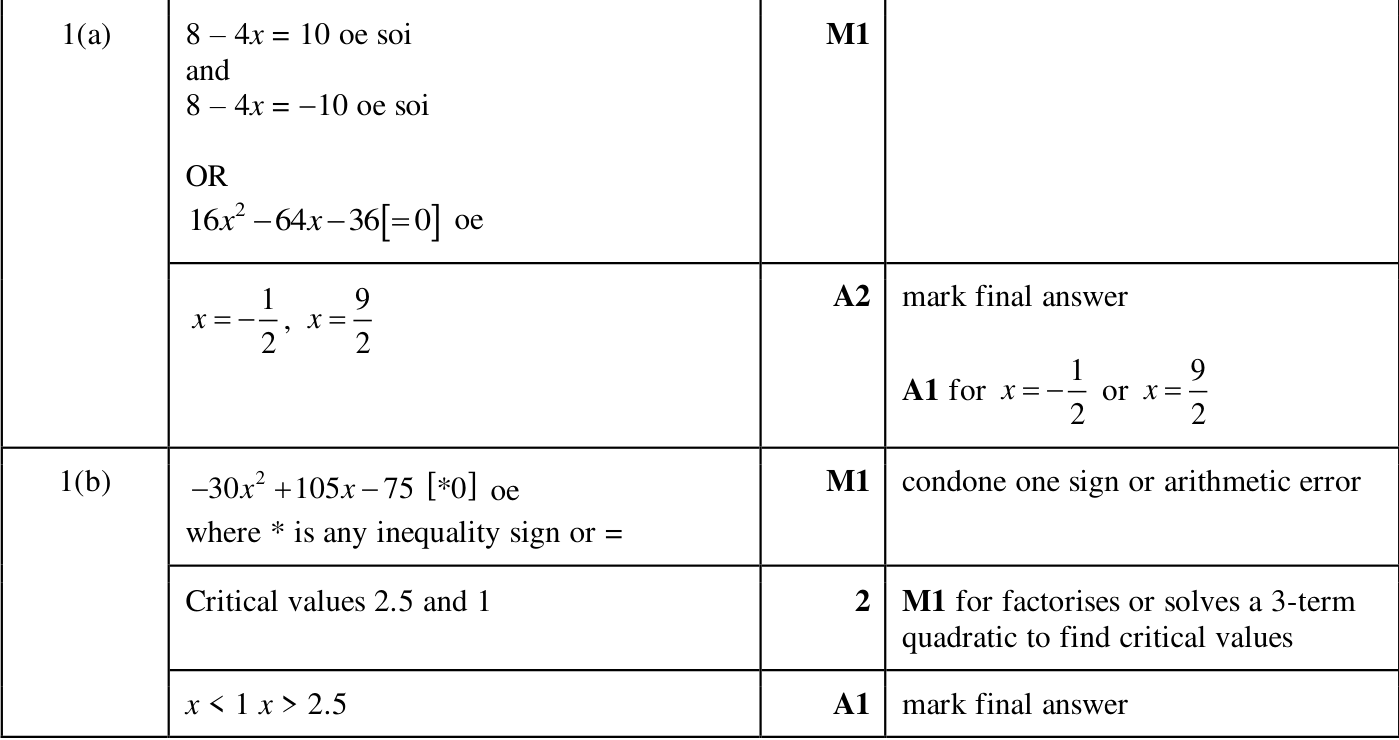
Answer: (a) \(x=-\frac12\) or \(x=\frac92\); (b) \(x\lt 1\) or \(x\gt \frac52\).
We start with the main method. Split the modulus expression into its equivalent linear cases, or compare the two sides graphically where a graph is requested.
(a) Start with
\(2|8-4x|+5=25.\)
Then
\(2|8-4x|=20,\)
so
\(|8-4x|=10.\)
Therefore
\(8-4x=10\quad\text{or}\quad 8-4x=-10.\)
These give
\(-4x=2\quad\text{or}\quad -4x=-18,\)
so
\(x=-\frac12\quad\text{or}\quad x=\frac92.\)
(b) Multiply the inequality by \(6\):
\(96x-30x^2-18\lt 57-9x.\)
Move all terms to one side:
\(-30x^2+105x-75\lt 0.\)
Divide by \(-15\), remembering that the inequality sign reverses:
\(2x^2-7x+5\gt 0.\)
Factorise:
\((2x-5)(x-1)\gt 0.\)
The critical values are \(x=1\) and \(x=\frac52\). A positive quadratic is positive outside the roots, so
\(x\lt 1\quad\text{or}\quad x\gt \frac52.\)
This completes the solution and gives the required result.