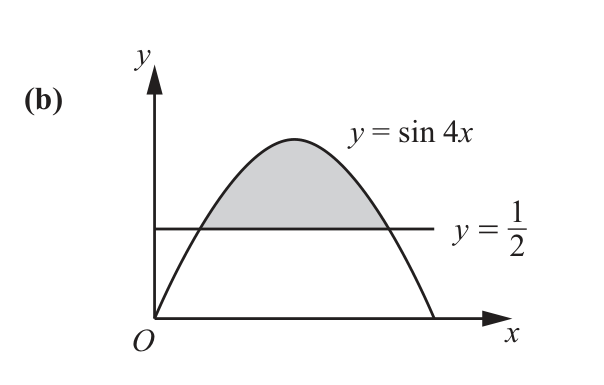
Answer: \(x=\frac{\pi}{24},\frac{5\pi}{24}\); area \(=\frac{\sqrt3}{4}-\frac{\pi}{12}\).
Start by taking the key information from the graph or diagram, such as intercepts, turning points, amplitudes, periods, or intersection points. Then use the relevant algebra to justify the result.
Since \(0\leqslant x\leqslant\frac{\pi}{4}\), we have \(0\leqslant4x\leqslant\pi\).
The equation \(\sin4x=\frac12\) gives
\(4x=\frac{\pi}{6}\) or \(4x=\frac{5\pi}{6}\).
Therefore
\(x=\frac{\pi}{24}\) or \(x=\frac{5\pi}{24}\).
The shaded area is
\(\int_{\pi/24}^{5\pi/24}\left(\sin4x-\frac12\right)\,\mathrm dx.\)
Now \(\int\sin4x\,\mathrm dx=-\frac14\cos4x\). Hence the area is
\(\left[-\frac14\cos4x-\frac{x}{2}\right]_{\pi/24}^{5\pi/24}.\)
The sine-curve part gives
\(-\frac14\cos\frac{5\pi}{6}+\frac14\cos\frac{\pi}{6}=\frac{\sqrt3}{4}.\)
The rectangle below the line has area
\(\frac12\left(\frac{5\pi}{24}-\frac{\pi}{24}\right)=\frac{\pi}{12}.\)
Therefore the required area is \(\frac{\sqrt3}{4}-\frac{\pi}{12}\).
The result has been obtained using the exact condition from the question, so no additional solutions are introduced.