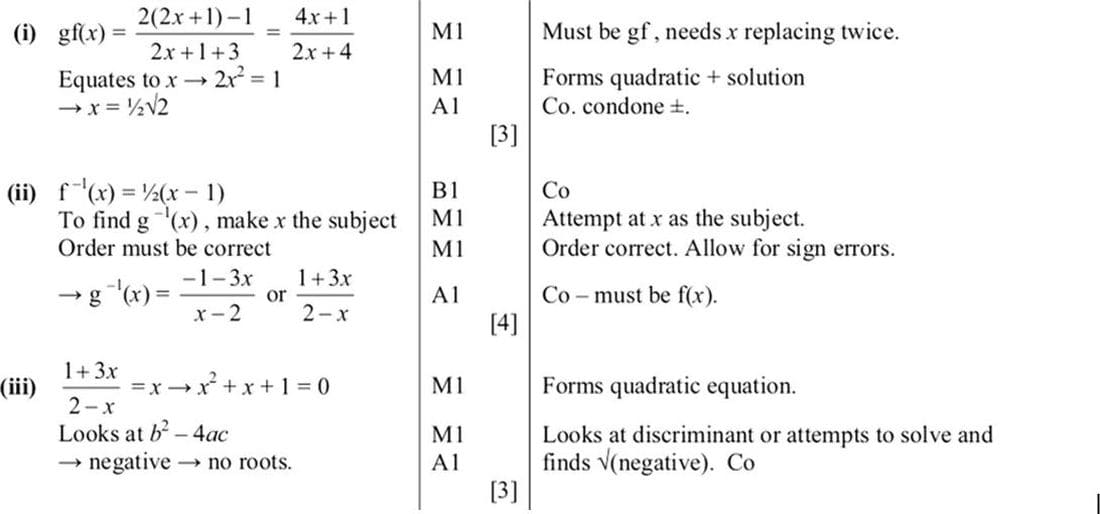
(i) To solve \(gf(x) = x\), substitute \(f(x) = 2x + 1\) into \(g(x)\):
\(gf(x) = \frac{2(2x + 1) - 1}{2x + 1 + 3} = \frac{4x + 1}{2x + 4}\)
Set \(\frac{4x + 1}{2x + 4} = x\) and solve for \(x\):
\(4x + 1 = x(2x + 4)\)
\(4x + 1 = 2x^2 + 4x\)
\(2x^2 = 1\)
\(x^2 = \frac{1}{2}\)
\(x = \frac{1}{2}\sqrt{2}\)
(ii) To find \(f^{-1}(x)\), solve \(y = 2x + 1\) for \(x\):
\(x = \frac{1}{2}(y - 1)\)
Thus, \(f^{-1}(x) = \frac{1}{2}(x - 1)\).
To find \(g^{-1}(x)\), solve \(y = \frac{2x - 1}{x + 3}\) for \(x\):
\(y(x + 3) = 2x - 1\)
\(yx + 3y = 2x - 1\)
\(yx - 2x = -3y - 1\)
\(x(y - 2) = -3y - 1\)
\(x = \frac{-3y - 1}{y - 2}\)
Thus, \(g^{-1}(x) = \frac{-1 - 3x}{x - 2}\) or \(\frac{1 + 3x}{2 - x}\).
(iii) To show \(g^{-1}(x) = x\) has no solutions, set \(\frac{-1 - 3x}{x - 2} = x\):
\(-1 - 3x = x(x - 2)\)
\(-1 - 3x = x^2 - 2x\)
\(x^2 + x + 1 = 0\)
The discriminant \(b^2 - 4ac = 1^2 - 4 \times 1 \times 1 = -3\), which is negative, indicating no real roots.