Browsing as Guest. Progress, bookmarks and attempts are disabled.
Log in to track your work.
June 2013 p13 q10
720
The function f is defined by \(f : x \mapsto 2x + k, \ x \in \mathbb{R}\), where \(k\) is a constant.
(i) In the case where \(k = 3\), solve the equation \(ff(x) = 25\).
The function g is defined by \(g : x \mapsto x^2 - 6x + 8, \ x \in \mathbb{R}\).
(ii) Find the set of values of \(k\) for which the equation \(f(x) = g(x)\) has no real solutions.
The function h is defined by \(h : x \mapsto x^2 - 6x + 8, \ x > 3\).
(iii) Find an expression for \(h^{-1}(x)\).
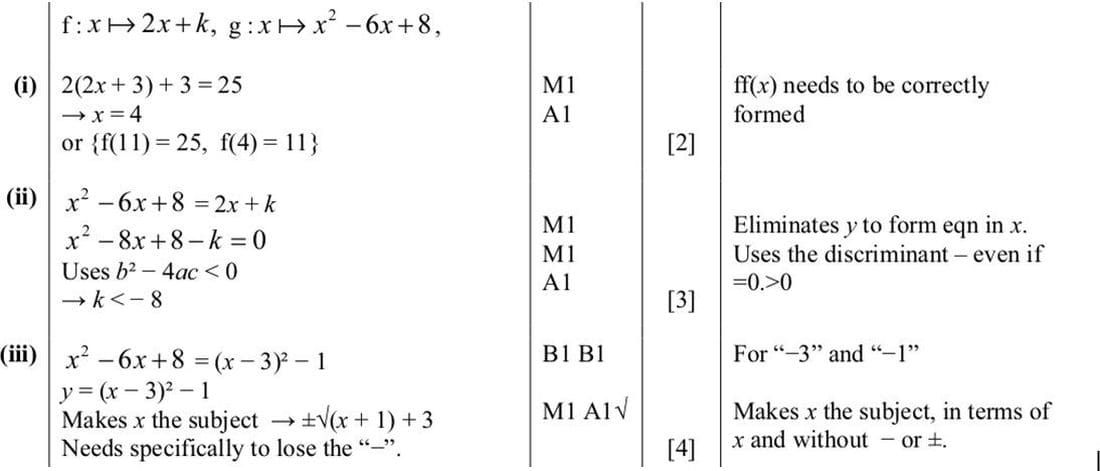
Solution
(i) The function \(f(x) = 2x + 3\). To find \(ff(x)\), we substitute \(f(x)\) into itself: \(f(f(x)) = f(2x + 3) = 2(2x + 3) + 3 = 4x + 6 + 3 = 4x + 9\). Set \(4x + 9 = 25\), solving gives \(x = 4\). Alternatively, \(f(11) = 25\) and \(f(4) = 11\).
(ii) Set \(f(x) = g(x)\): \(2x + k = x^2 - 6x + 8\). Rearrange to \(x^2 - 8x + 8 - k = 0\). For no real solutions, the discriminant \(b^2 - 4ac < 0\). Here, \(a = 1, b = -8, c = 8-k\). So, \((-8)^2 - 4(1)(8-k) < 0\) simplifies to \(64 - 32 + 4k < 0\), giving \(k < -8\).