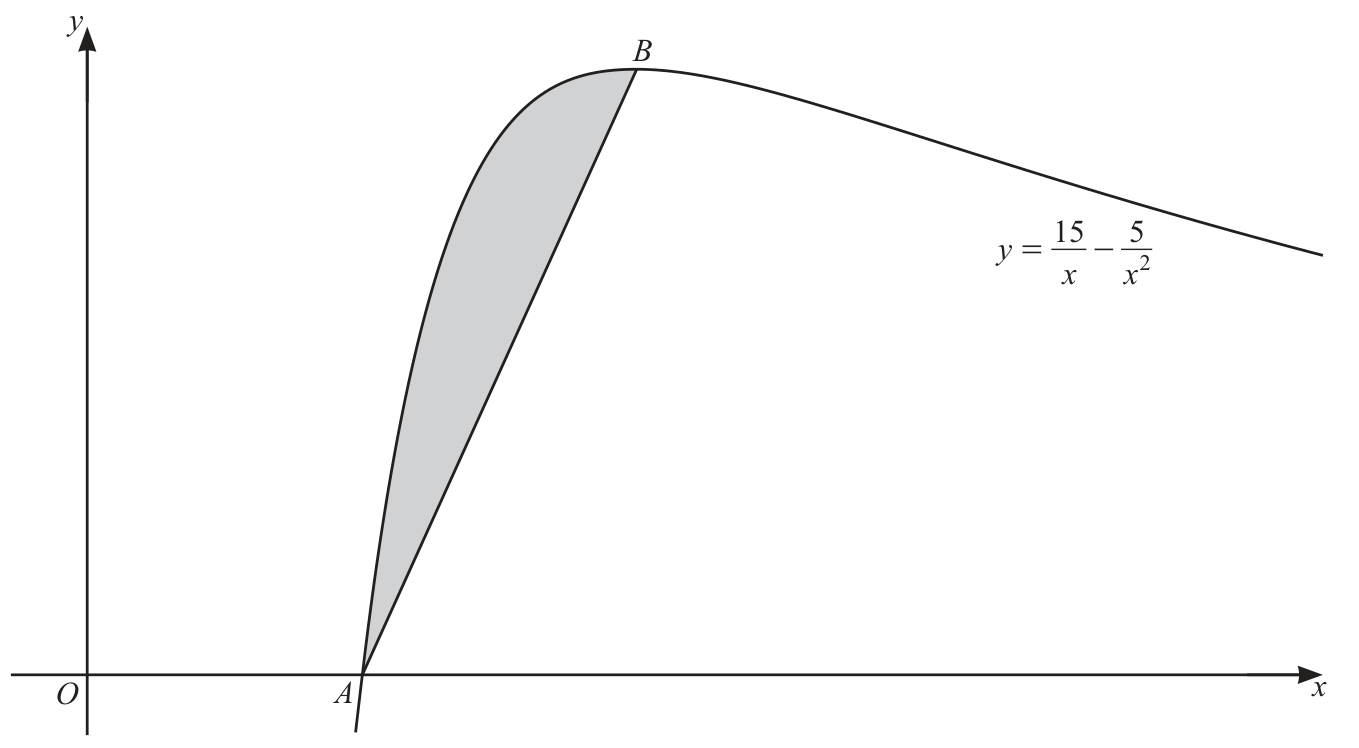
Answer: \(15\ln2-\frac{75}{8}\).
At \(A\), the curve meets the \(x\)-axis, so
\(\frac{15}{x}-\frac{5}{x^2}=0.\)
Multiplying by \(x^2\) gives \(15x-5=0\), so
\(A\left(\frac13,0\right).\)
Differentiate the curve:
\(\frac{\mathrm{d}y}{\mathrm{d}x}=-\frac{15}{x^2}+\frac{10}{x^3}.\)
At the maximum point \(B\), \(\frac{\mathrm{d}y}{\mathrm{d}x}=0\), so
\(-15x+10=0.\)
Hence \(x=\frac23\). Then
\(y=\frac{15}{2/3}-\frac{5}{(2/3)^2}=\frac{45}{2}-\frac{45}{4}=\frac{45}{4}.\)
So
\(B\left(\frac23,\frac{45}{4}\right).\)
The shaded area is the area under the curve from \(x=\frac13\) to \(x=\frac23\), minus the triangular area under the line \(AB\).
First integrate the curve:
\(\int\left(\frac{15}{x}-\frac{5}{x^2}\right)\,\mathrm{d}x=15\ln x+\frac{5}{x}.\)
Therefore
\(\int_{1/3}^{2/3}\left(\frac{15}{x}-\frac{5}{x^2}\right)\,\mathrm{d}x=15\ln2-\frac{15}{2}.\)
The triangle under \(AB\) has base
\(\frac23-\frac13=\frac13\)
and height \(\frac{45}{4}\). Its area is
\(\frac12\cdot\frac13\cdot\frac{45}{4}=\frac{15}{8}.\)
Hence the shaded area is
\(15\ln2-\frac{15}{2}-\frac{15}{8}=15\ln2-\frac{75}{8}.\)