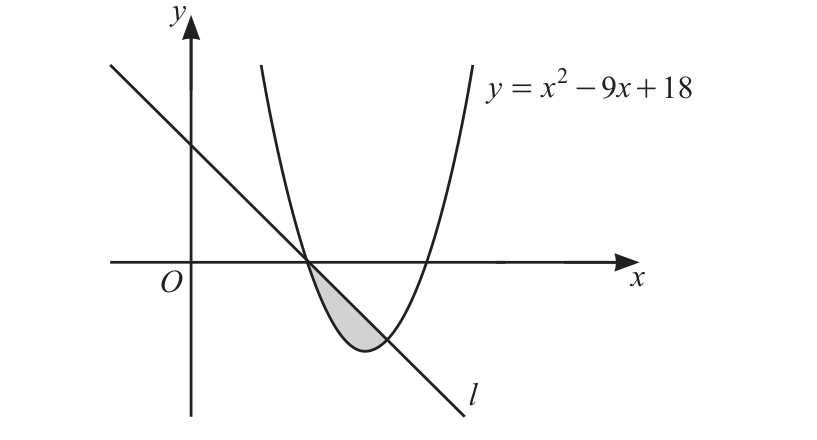
Answer: area \(=\frac43\).
The curve is
\(y=x^2-9x+18.\)
Differentiate to find the gradient of the tangent:
\(\dfrac{\mathrm dy}{\mathrm dx}=2x-9.\)
At \(x=5\),
\(\dfrac{\mathrm dy}{\mathrm dx}=2(5)-9=1.\)
Therefore the gradient of the normal is the negative reciprocal, so it is
\(-1.\)
The point on the curve where \(x=5\) has
\(y=25-45+18=-2,\)
so the point is \((5,-2)\). The equation of the normal is
\(y+2=-(x-5),\)
which simplifies to
\(y=-x+3.\)
Find where this line meets the curve:
\(x^2-9x+18=-x+3.\)
So
\(x^2-8x+15=0,\)
and hence
\((x-3)(x-5)=0.\)
The two intersections are at \(x=3\) and \(x=5\).
Between these values, for example at \(x=4\), the line has value \(-1\), while the curve has value \(-2\), so the line is above the curve. The required area is therefore
\(\displaystyle \int_3^5\left[(-x+3)-(x^2-9x+18)\right] \,\mathrm dx.\)
Simplify the integrand:
\((-x+3)-(x^2-9x+18)=-x^2+8x-15.\)
So the area is
\(\displaystyle \int_3^5(-x^2+8x-15)\,\mathrm dx =\left[-\dfrac{x^3}{3}+4x^2-15x\right]_3^5.\)
Substituting the limits gives
\(\left(-\dfrac{125}{3}+100-75\right)-\left(-9+36-45\right)=\dfrac43.\)
Therefore the area is
\(\dfrac43.\)