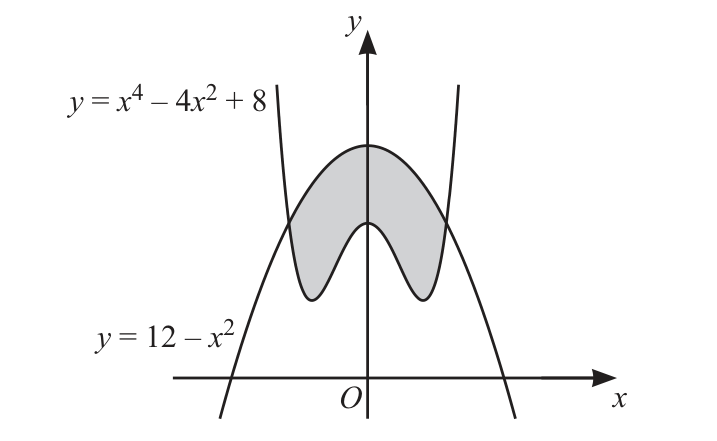
Answer: \(\frac{96}{5}\).
Find the points of intersection by equating the two curves:
\(12-x^2=x^4-4x^2+8.\)
Rearranging,
\(x^4-3x^2-4=0.\)
Treat this as a quadratic in \(x^2\):
\((x^2-4)(x^2+1)=0.\)
The real solutions come from \(x^2-4=0\), so
\(x=-2\quad\text{or}\quad x=2.\)
Between \(-2\) and \(2\), for example at \(x=0\), the curve \(y=12-x^2\) has value \(12\), while \(y=x^4-4x^2+8\) has value \(8\). So \(12-x^2\) is above \(x^4-4x^2+8\) on the enclosed region.
The required area is
\(\displaystyle \int_{-2}^{2}\left[(12-x^2)-(x^4-4x^2+8)\right] \,\mathrm dx.\)
Simplifying the integrand gives
\(4+3x^2-x^4.\)
Therefore
\(\displaystyle \text{area}=\int_{-2}^{2}(4+3x^2-x^4)\,\mathrm dx.\)
The integrand is even, so this could also be written as twice the integral from \(0\) to \(2\). Directly integrating gives
\(\left[4x+x^3-\dfrac{x^5}{5}\right]_{-2}^{2}.\)
Substitute the limits:
\(\left(8+8-\dfrac{32}{5}\right)-\left(-8-8+\dfrac{32}{5}\right)=\dfrac{96}{5}.\)
Hence the shaded area is
\(\dfrac{96}{5}.\)