Answer: \(\sec30^\circ=\frac{2}{\sqrt3}\), and \(\dfrac{1}{\sec x-1}+\dfrac{1}{\sec x+1}=2\operatorname{cosec}x\cot x\).
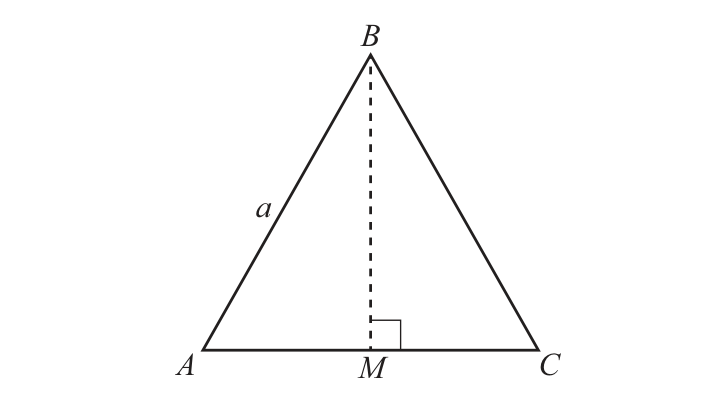
(a) In the equilateral triangle, each side is \(a\). Since \(M\) is the midpoint of \(AC\),
\(AM=\dfrac a2.\)
The line \(BM\) is perpendicular to \(AC\), so triangle \(ABM\) is right-angled. The angle at \(B\) is \(30^\circ\).
Using Pythagoras,
\(BM=\sqrt{a^2-\left(\dfrac a2\right)^2}=\sqrt{\dfrac{3a^2}{4}}=\dfrac{\sqrt3}{2}a.\)
For the angle \(30^\circ\),
\(\cos30^\circ=\dfrac{BM}{AB}=\dfrac{\frac{\sqrt3}{2}a}{a}=\dfrac{\sqrt3}{2}.\)
Therefore
\(\sec30^\circ=\dfrac1{\cos30^\circ}=\dfrac2{\sqrt3}.\)
(b) Start with
\(\dfrac{1}{\sec x-1}+\dfrac{1}{\sec x+1}.\)
Use a common denominator:
\(\dfrac{(\sec x+1)+(\sec x-1)}{(\sec x-1)(\sec x+1)}.\)
The numerator simplifies to \(2\sec x\), and the denominator is
\(\sec^2x-1.\)
Since \(\sec^2x-1=\tan^2x\), the expression becomes
\(\dfrac{2\sec x}{\tan^2x}.\)
Now write everything in terms of \(\sin x\) and \(\cos x\):
\(\dfrac{2\cdot\frac1{\cos x}}{\frac{\sin^2x}{\cos^2x}} =\dfrac{2}{\cos x}\cdot\dfrac{\cos^2x}{\sin^2x} =\dfrac{2\cos x}{\sin^2x}.\)
Finally,
\(\dfrac{2\cos x}{\sin^2x}=2\left(\dfrac1{\sin x}\right)\left(\dfrac{\cos x}{\sin x}\right)=2\operatorname{cosec}x\cot x.\)
This proves the identity.