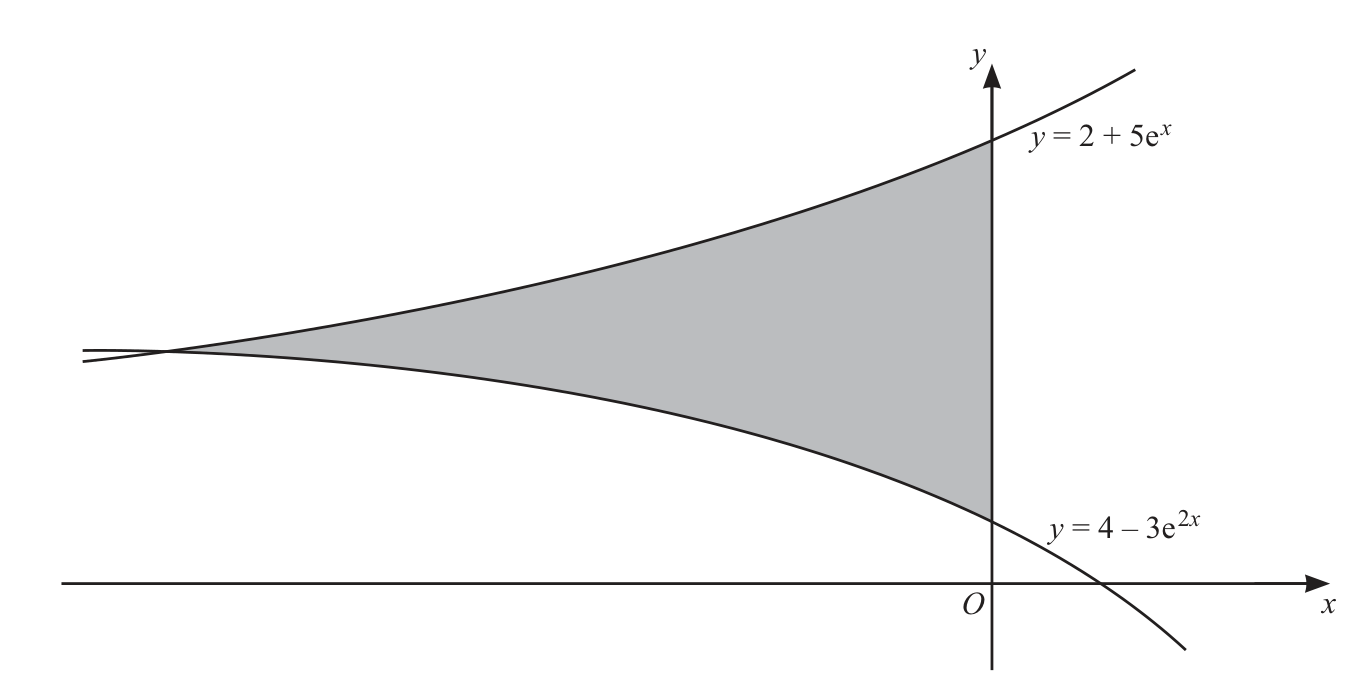
Answer: \(\dfrac{14}{3}-2\ln3\).
The two curves meet where
\(2+5\mathrm{e}^x=4-3\mathrm{e}^{2x}\).
Let \(u=\mathrm{e}^x\). Since \(\mathrm{e}^x\gt0\), we need \(u\gt0\). The equation becomes
\(2+5u=4-3u^2\).
Rearranging,
\(3u^2+5u-2=0\).
Factorising,
\((3u-1)(u+2)=0\).
Since \(u\gt0\), we take
\(u=\frac13\).
Thus
\(\mathrm{e}^x=\frac13\), so \(x=-\ln3\).
The other vertical boundary shown is the \(y\)-axis, \(x=0\). On the interval \(-\ln3\leqslant x\leqslant0\), the curve
\(y=2+5\mathrm{e}^x\)
lies above
\(y=4-3\mathrm{e}^{2x}\).
Therefore the shaded area is
\(\displaystyle \int_{-\ln3}^{0}\left[(2+5\mathrm{e}^x)-(4-3\mathrm{e}^{2x})\right]\,\mathrm{d}x\).
Simplifying the integrand,
\((2+5\mathrm{e}^x)-(4-3\mathrm{e}^{2x})=3\mathrm{e}^{2x}+5\mathrm{e}^x-2\).
So the area is
\(\displaystyle \int_{-\ln3}^{0}(3\mathrm{e}^{2x}+5\mathrm{e}^x-2)\,\mathrm{d}x\).
An antiderivative is
\(\dfrac32\mathrm{e}^{2x}+5\mathrm{e}^x-2x\).
Substituting the limits gives
\(\left[\dfrac32\mathrm{e}^{2x}+5\mathrm{e}^x-2x\right]_{-\ln3}^{0}\).
At \(x=0\), this is
\(\dfrac32+5=\dfrac{13}{2}\).
At \(x=-\ln3\), \(\mathrm{e}^x=\frac13\) and \(\mathrm{e}^{2x}=\frac19\), so the value is
\(\dfrac32\cdot\dfrac19+5\cdot\dfrac13-2(-\ln3)=\dfrac16+\dfrac53+2\ln3=\dfrac{11}{6}+2\ln3\).
Hence the area is
\(\dfrac{13}{2}-\left(\dfrac{11}{6}+2\ln3\right)=\dfrac{14}{3}-2\ln3\).