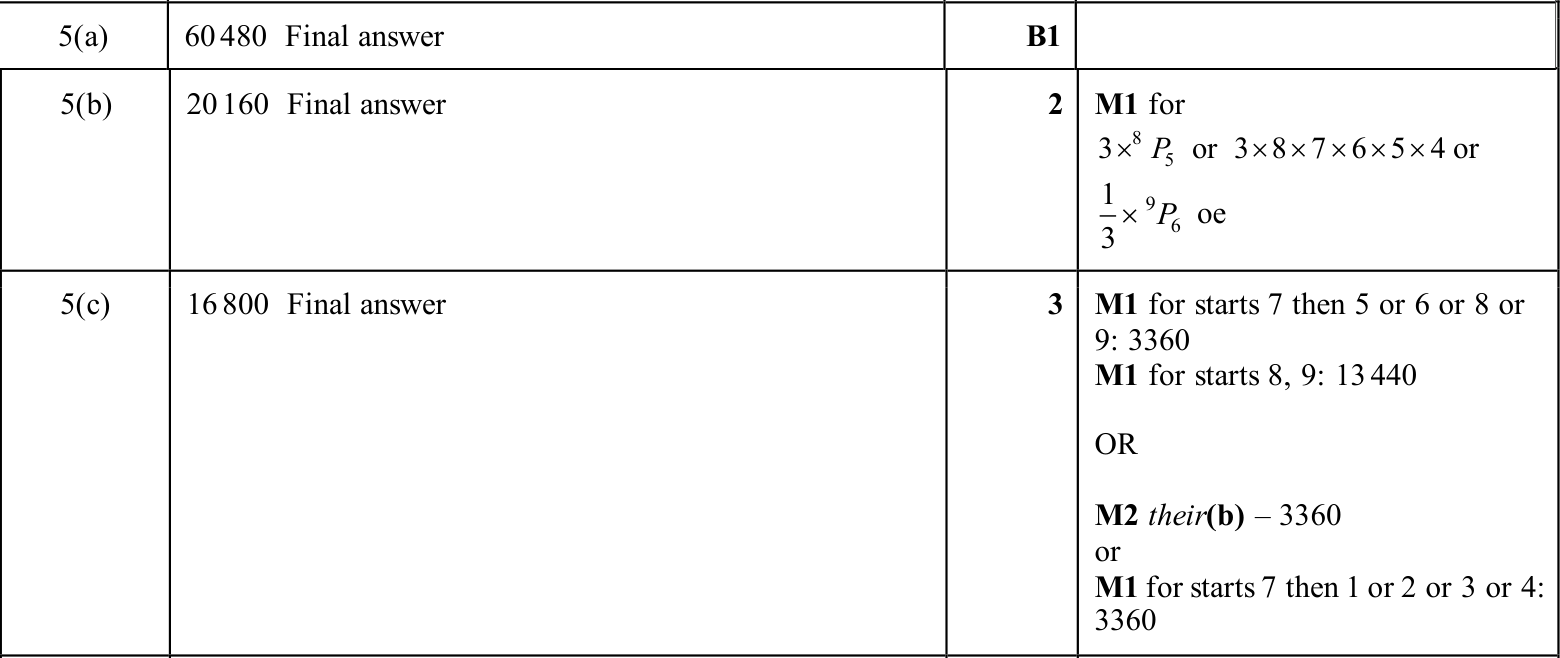
Answer: (a) \(60480\), (b) \(20160\), (c) \(16800\).
(a) A 6-digit number is formed by arranging \(6\) different digits chosen from the \(9\) digits \(1,2,3,4,5,6,7,8,9\).
So the number of possible numbers is
\({}^{9}P_6=9\times8\times7\times6\times5\times4=60480\).
(b) For the number to be greater than \(700000\), the first digit must be \(7\), \(8\), or \(9\).
There are \(3\) choices for the first digit.
After choosing the first digit, there are \(8\) digits left, and the remaining five positions can be filled in
\({}^{8}P_5=8\times7\times6\times5\times4\)
ways.
Therefore the number of possible numbers is
\(3\times{}^{8}P_5=3\times8\times7\times6\times5\times4=20160\).
(c) For the number to be greater than \(750000\), split into cases.
Case 1: The first digit is \(8\) or \(9\). There are \(2\) choices for the first digit, and then the remaining five positions can be filled in \({}^{8}P_5\) ways. This gives
\(2\times{}^{8}P_5=2\times8\times7\times6\times5\times4=13440\).
Case 2: The first digit is \(7\). Then the second digit must be \(5\), \(6\), \(8\), or \(9\) to make the number greater than \(750000\). This gives \(4\) choices for the second digit.
After choosing the first two digits, \(7\) digits remain, and the last four positions can be filled in
\({}^{7}P_4=7\times6\times5\times4\)
ways. This gives
\(4\times{}^{7}P_4=4\times7\times6\times5\times4=3360\).
Total:
\(13440+3360=16800\).