9231 P31 - Jun 2020 - Q4 - 7 marks
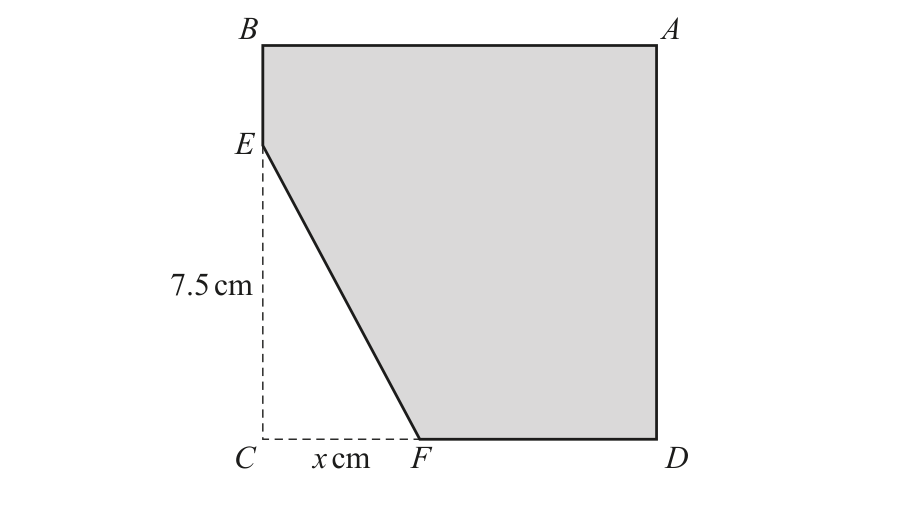
A uniform square lamina \(A B C D\) has sides of length 10 cm . The point \(E\) is on \(B C\) with \(E C=7.5 \mathrm{~cm}\), and the point \(F\) is on \(D C\) with \(C F=x \mathrm{~cm}\). The triangle \(E F C\) is removed from \(A B C D\) (see diagram). The centre of mass of the resulting shape \(A B E F D\) is a distance \(\bar{x} \mathrm{~cm}\) from \(C B\) and a distance \(\bar{y} \mathrm{~cm}\) from \(C D\).
(a) Show that \(\bar{x}=\frac{400-x^{2}}{80-3 x}\) and find a corresponding expression for \(\bar{y}\).
The shape \(A B E F D\) is in equilibrium in a vertical plane with the edge \(D F\) resting on a smooth horizontal surface.
(b) Find the greatest possible value of \(x\), giving your answer in the form \(a+b \sqrt{2}\), where \(a\) and \(b\) are constants to be determined.