9231 P31 - Jun 2023 - Q4 - 8 marks
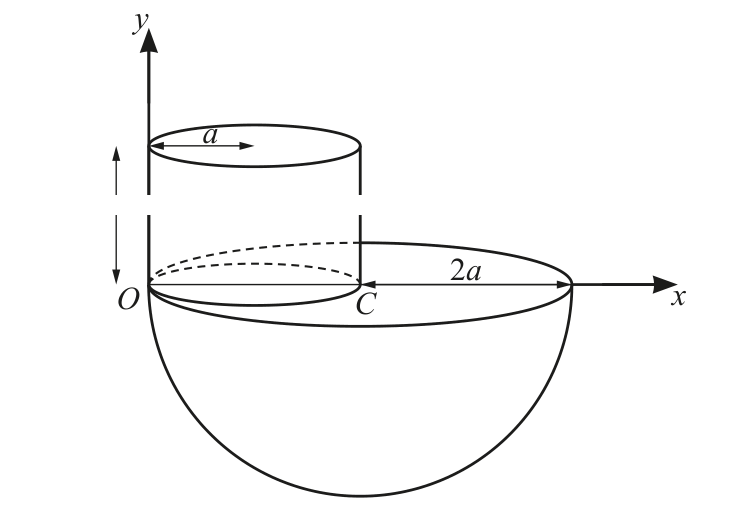
An object is formed from a solid hemisphere, of radius \(2 a\), and a solid cylinder, of radius \(a\) and height \(d\). The hemisphere and the cylinder are made of the same material. The cylinder is attached to the plane face of the hemisphere. The line \(O C\) forms a diameter of the base of the cylinder, where \(C\) is the centre of the plane face of the hemisphere and \(O\) is common to both circumferences (see diagram). Relative to axes through \(O\), parallel and perpendicular to \(O C\) as shown, the centre of mass of the object is \((\bar{x}, \bar{y})\).
(a) Show that \(\bar{x}=\frac{32 a^{2}+3 a d}{16 a+3 d}\) and find an expression, in terms of \(a\) and \(d\), for \(\bar{y}\).
The object is placed on a rough plane which is inclined to the horizontal at an angle \(\theta\) where \(\sin \theta=\frac{1}{6}\). The object is in equilibrium with \(C O\) horizontal, where \(C O\) lies in a vertical plane through a line of greatest slope.
(b) Find \(d\) in terms of \(a\).