Answer: Let
\(H_0: \mu_A=\mu_B\)
\(H_1: \mu_A\neq\mu_B\)
Sample means:
\(\bar x=\frac{282}{50}=5.64\), \(\bar y=\frac{328}{60}=5.4667\)
Sample variances:
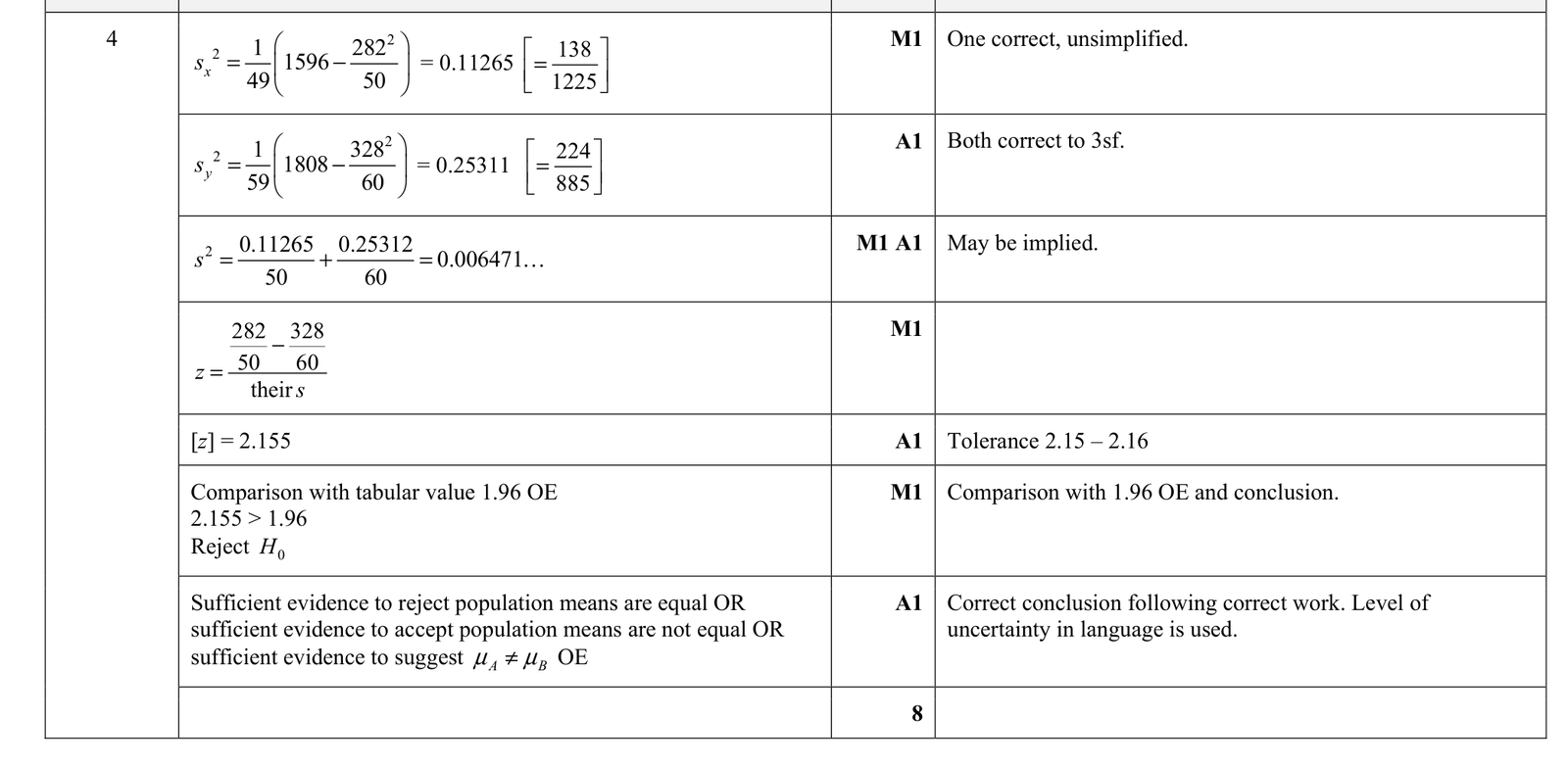
\(s_x^2=\frac{1}{49}\left(1596-\frac{282^2}{50}\right)=0.11265\)
\(s_y^2=\frac{1}{59}\left(1808-\frac{328^2}{60}\right)=0.25311\)
Standard error of \(\bar x-\bar y\):
\(\sqrt{\frac{s_x^2}{50}+\frac{s_y^2}{60}}=\sqrt{0.006471\ldots}=0.08044\)
Test statistic:
\(z=\frac{5.64-5.4667}{0.08044}=2.155\)
For a two-tailed test at the 5% level, the critical value is \(1.96\).
Since \(|z|=2.155\gt1.96\), reject \(H_0\).
There is sufficient evidence at the 5% significance level to conclude that the population mean leaf lengths in regions \(A\) and \(B\) are different.
We test whether the population mean leaf lengths are the same in the two regions.
Take
\(H_0: \mu_A=\mu_B\)
\(H_1: \mu_A\neq\mu_B\)
This is a two-tailed test.
First find the sample means.
For region \(A\), with \(n_A=50\),
\(\bar x=\frac{\sum x}{50}=\frac{282}{50}=5.64\)
For region \(B\), with \(n_B=60\),
\(\bar y=\frac{\sum y}{60}=\frac{328}{60}=5.4667\)
Now find the unbiased sample variances.
For region \(A\),
\(s_x^2=\frac{1}{50-1}\left(\sum x^2-\frac{(\sum x)^2}{50}\right)\)
\(=\frac{1}{49}\left(1596-\frac{282^2}{50}\right)\)
\(=\frac{1}{49}(1596-1590.48)=0.11265\)
For region \(B\),
\(s_y^2=\frac{1}{60-1}\left(\sum y^2-\frac{(\sum y)^2}{60}\right)\)
\(=\frac{1}{59}\left(1808-\frac{328^2}{60}\right)\)
\(=\frac{1}{59}(1808-1793.0667)=0.25311\)
Since both sample sizes are large, we use a large-sample test for the difference of means.
Under \(H_0\), the standard error of \(\bar x-\bar y\) is
\(\sqrt{\frac{s_x^2}{50}+\frac{s_y^2}{60}}\)
\(=\sqrt{\frac{0.11265}{50}+\frac{0.25311}{60}}\)
\(=\sqrt{0.002253+0.0042185}\)
\(=\sqrt{0.0064715}=0.08044\)
So the test statistic is
\(z=\frac{\bar x-\bar y}{\sqrt{\frac{s_x^2}{50}+\frac{s_y^2}{60}}}\)
\(=\frac{5.64-5.4667}{0.08044}\)
\(=2.155\)
At the 5% significance level for a two-tailed test, the critical values are \(\pm 1.96\).
Since \(2.155\gt1.96\), the test statistic lies in the critical region.
Therefore we reject \(H_0\).
There is sufficient evidence to suggest that \(\mu_A\neq\mu_B\). In context, the mean leaf lengths in regions \(A\) and \(B\) are significantly different.