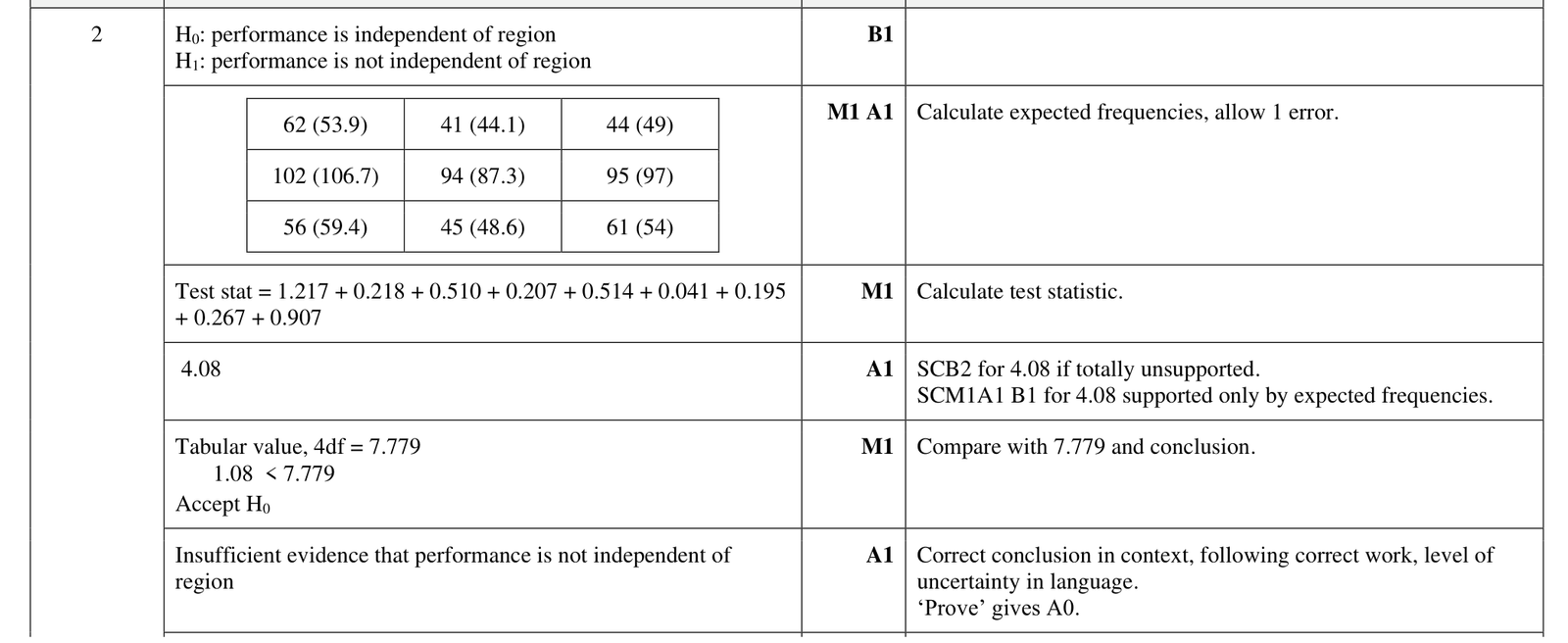
Answer: Let \(H_0\) be: performance is independent of region.
Let \(H_1\) be: performance is not independent of region.
The expected frequencies are:
| A | B | C |
|---|
| Above target | \(53.9\) | \(44.1\) | \(49.0\) |
|---|
| On target | \(106.7\) | \(87.3\) | \(97.0\) |
|---|
| Below target | \(59.4\) | \(48.6\) | \(54.0\) |
|---|
The chi-squared test statistic is \(\chi^2 \approx 4.08\).
Degrees of freedom: \((3-1)(3-1)=4\).
At the \(10\%\) significance level, the critical value is \(7.779\).
Since \(4.08 \lt 7.779\), do not reject \(H_0\).
There is insufficient evidence to suggest that performance depends on region, so performance can be treated as independent of region.
We use a chi-squared test of independence.
Hypotheses:
- \(H_0\): performance is independent of region
- \(H_1\): performance is not independent of region
The expected frequency in each cell is
\(\text{expected} = \frac{(\text{row total})(\text{column total})}{\text{grand total}}\).
Using the totals given:
| A | B | C | Total |
|---|
| Above target | \(62\; (53.9)\) | \(41\; (44.1)\) | \(44\; (49.0)\) | \(147\) |
|---|
| On target | \(102\; (106.7)\) | \(94\; (87.3)\) | \(95\; (97.0)\) | \(291\) |
|---|
| Below target | \(56\; (59.4)\) | \(45\; (48.6)\) | \(61\; (54.0)\) | \(162\) |
|---|
| Total | \(220\) | \(180\) | \(200\) | \(600\) |
|---|
For example,
\(E(\text{Above, A}) = \frac{147\times 220}{600}=53.9\),
\(E(\text{On, B}) = \frac{291\times 180}{600}=87.3\).
Now calculate
\(\chi^2 = \sum \frac{(O-E)^2}{E}\).
The contributions are:
| Cell | \(\frac{(O-E)^2}{E}\) |
|---|
| Above, A | \(\frac{(62-53.9)^2}{53.9} \approx 1.217\) |
| Above, B | \(\frac{(41-44.1)^2}{44.1} \approx 0.218\) |
| Above, C | \(\frac{(44-49.0)^2}{49.0} \approx 0.510\) |
| On, A | \(\frac{(102-106.7)^2}{106.7} \approx 0.207\) |
| On, B | \(\frac{(94-87.3)^2}{87.3} \approx 0.514\) |
| On, C | \(\frac{(95-97.0)^2}{97.0} \approx 0.041\) |
| Below, A | \(\frac{(56-59.4)^2}{59.4} \approx 0.195\) |
| Below, B | \(\frac{(45-48.6)^2}{48.6} \approx 0.267\) |
| Below, C | \(\frac{(61-54.0)^2}{54.0} \approx 0.907\) |
So
\(\chi^2 \approx 1.217+0.218+0.510+0.207+0.514+0.041+0.195+0.267+0.907 = 4.08\).
The number of degrees of freedom is
\((3-1)(3-1)=4\).
At the \(10\%\) significance level, the critical value for \(4\) degrees of freedom is \(7.779\).
Since \(4.08 \lt 7.779\), the test statistic is not in the critical region, so we do not reject \(H_0\).
Conclusion: there is insufficient evidence to suggest that student performance depends on region. The data are consistent with performance being independent of region.