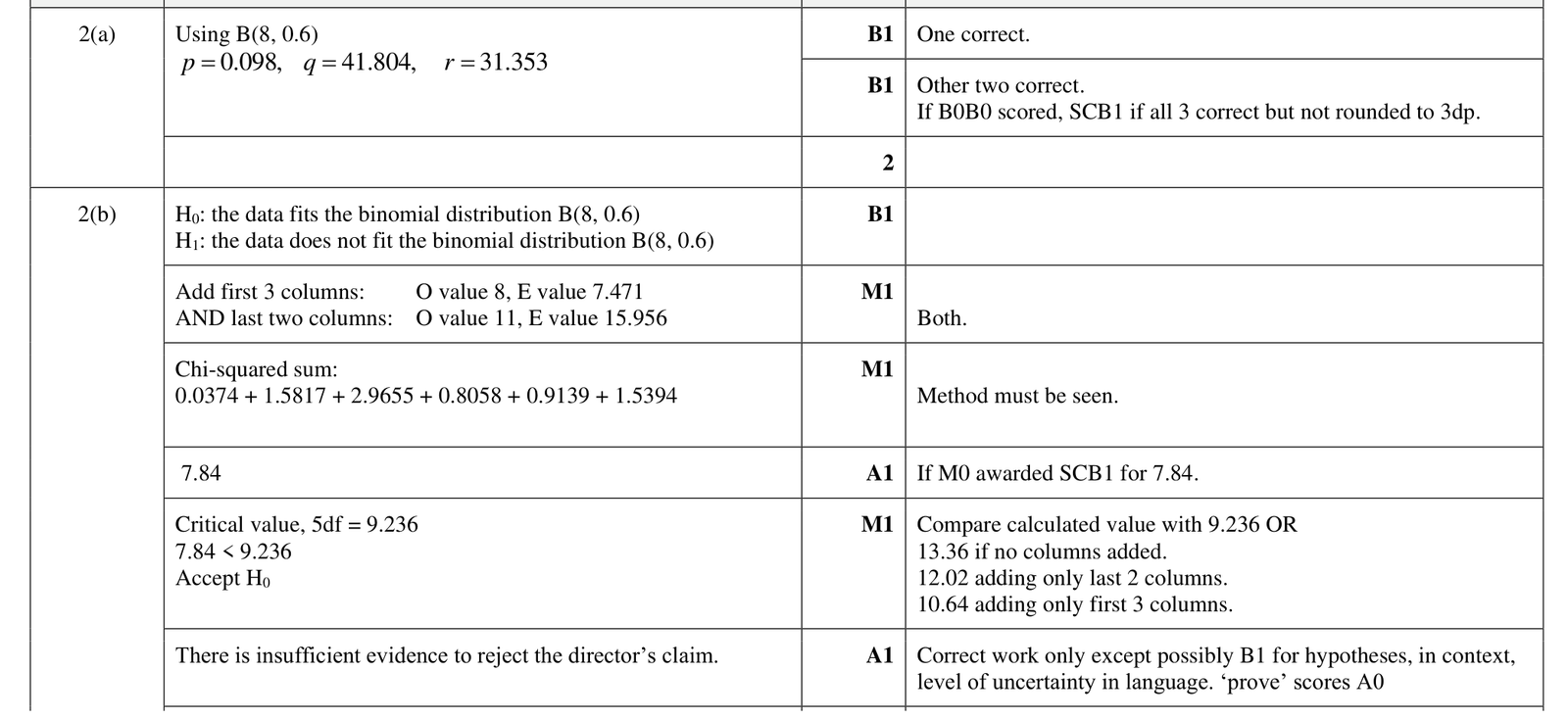
Answer: (a) \(p=0.098\), \(q=41.804\), \(r=31.353\).
(b) Using a \(\chi^2\) goodness-of-fit test with suitable grouping, the test statistic is \(\chi^2=7.84\) with \(5\) degrees of freedom. Since \(7.84 \lt 9.236\) at the 10% significance level, we do not reject \(H_0\).
There is insufficient evidence to say the data does not fit \(\mathrm{B}(8,0.6)\), so the director's claim is consistent with the observations.
(a) The number of passes in a group of 8 is modelled by \(X\sim \mathrm{B}(8,0.6)\).
For 150 groups, the expected frequency for \(X=r\) is
\(150\times \Pr(X=r)=150\times \binom{8}{r}(0.6)^r(0.4)^{8-r}\).
So
\(p=150\times \Pr(X=0)=150\times (0.4)^8=150\times 0.00065536=0.098304\).
Hence \(p=0.098\) to 3 d.p.
\(q=150\times \Pr(X=5)=150\times \binom{8}{5}(0.6)^5(0.4)^3\)
\(=150\times 56\times 0.07776\times 0.064=41.803776\).
Hence \(q=41.804\).
\(r=150\times \Pr(X=6)=150\times \binom{8}{6}(0.6)^6(0.4)^2\)
\(=150\times 28\times 0.046656\times 0.16=31.352832\).
Hence \(r=31.353\).
(b) We test
\(H_0\): the data follow a binomial distribution \(\mathrm{B}(8,0.6)\).
\(H_1\): the data do not follow a binomial distribution \(\mathrm{B}(8,0.6)\).
The observed and expected frequencies are:
| Number of passes | 0 | 1 | 2 | 3 | 4 | 5 | 6 | 7 | 8 |
|---|
| Observed | 0 | 0 | 8 | 24 | 45 | 36 | 26 | 10 | 1 |
|---|
| Expected | 0.098 | 1.180 | 6.193 | 18.579 | 34.836 | 41.804 | 31.353 | 13.437 | 2.519 |
|---|
For a valid \(\chi^2\) test, expected frequencies should not be too small, so we combine the first three categories and the last two categories:
| Grouped category | 0,1,2 | 3 | 4 | 5 | 6 | 7,8 |
|---|
| Observed | 8 | 24 | 45 | 36 | 26 | 11 |
|---|
| Expected | \(0.098+1.180+6.193=7.471\) | 18.579 | 34.836 | 41.804 | 31.353 | \(13.437+2.519=15.956\) |
|---|
Now calculate
\(\chi^2=\sum \frac{(O-E)^2}{E}\).
This gives
\(\chi^2=\frac{(8-7.471)^2}{7.471}+\frac{(24-18.579)^2}{18.579}+\frac{(45-34.836)^2}{34.836}+\frac{(36-41.804)^2}{41.804}+\frac{(26-31.353)^2}{31.353}+\frac{(11-15.956)^2}{15.956}\)
\(=0.0374+1.5817+2.9655+0.8058+0.9139+1.5394\)
\(=7.8437\approx 7.84\).
There are \(6\) grouped categories, and no parameters have been estimated from the data, so
degrees of freedom \(=6-1=5\).
At the 10% significance level, the critical value for \(\chi^2\) with \(5\) degrees of freedom is \(9.236\).
Since \(7.84 \lt 9.236\), we do not reject \(H_0\).
So there is insufficient evidence to conclude that the distribution of passes differs from \(\mathrm{B}(8,0.6)\). The director's claim is consistent with the data.