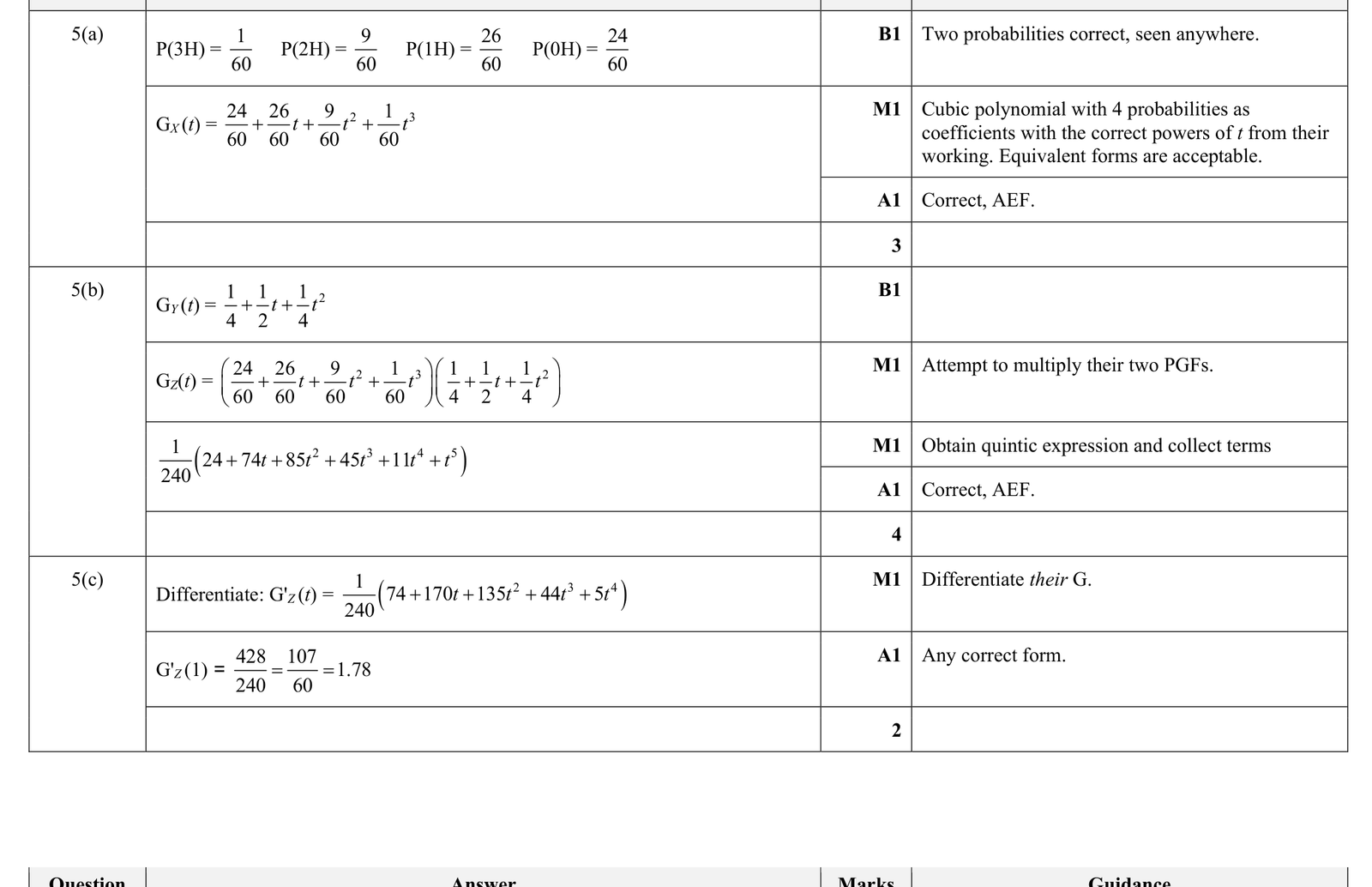
Answer: (a) \(G_X(t)=\frac{24}{60}+\frac{26}{60}t+\frac{9}{60}t^2+\frac{1}{60}t^3\).
(b) \(G_Z(t)=\frac{1}{240}\left(24+74t+85t^2+45t^3+11t^4+t^5\right)\).
(c) \(\mathrm{E}(Z)=G_Z'(1)=\frac{107}{60}\).
(a) For Harry's three coins, the probabilities of heads are \(\frac13,\frac14,\frac15\), so the probabilities of tails are \(\frac23,\frac34,\frac45\).
We find the distribution of \(X\), the number of heads.
- \(P(X=3)=\frac13\cdot\frac14\cdot\frac15=\frac1{60}\).
- \(P(X=0)=\frac23\cdot\frac34\cdot\frac45=\frac{24}{60}\).
- \(P(X=2)\) is the sum of the three ways of getting exactly two heads:
\(\frac13\cdot\frac14\cdot\frac45+\frac13\cdot\frac34\cdot\frac15+\frac23\cdot\frac14\cdot\frac15=\frac4{60}+\frac3{60}+\frac2{60}=\frac9{60}.\)
- \(P(X=1)\) is the sum of the three ways of getting exactly one head:
\(\frac13\cdot\frac34\cdot\frac45+\frac23\cdot\frac14\cdot\frac45+\frac23\cdot\frac34\cdot\frac15=\frac{12}{60}+\frac8{60}+\frac6{60}=\frac{26}{60}.\)
Therefore the probability generating function is
\(G_X(t)=P(X=0)+P(X=1)t+P(X=2)t^2+P(X=3)t^3\)
so
\(G_X(t)=\frac{24}{60}+\frac{26}{60}t+\frac{9}{60}t^2+\frac{1}{60}t^3.\)
(b) Isaac has two fair coins, so for \(Y\), the number of heads:
\(P(Y=0)=\frac14,\quad P(Y=1)=\frac12,\quad P(Y=2)=\frac14.\)
Hence
\(G_Y(t)=\frac14+\frac12 t+\frac14 t^2.\)
Since \(Z=X+Y\) and the throws are independent,
\(G_Z(t)=G_X(t)G_Y(t).\)
So
\(G_Z(t)=\left(\frac{24}{60}+\frac{26}{60}t+\frac{9}{60}t^2+\frac{1}{60}t^3\right)\left(\frac14+\frac12 t+\frac14 t^2\right).\)
Write this with denominator \(240\):
\(G_Z(t)=\frac1{240}(96+104t+36t^2+4t^3)(1+2t+t^2).\)
Now expand:
constant term: \(96\)
coefficient of \(t\): \(192+104=296\)
coefficient of \(t^2\): \(96+208+36=340\)
coefficient of \(t^3\): \(104+72+4=180\)
coefficient of \(t^4\): \(36+8=44\)
coefficient of \(t^5\): \(4\)
Thus
\(G_Z(t)=\frac1{240}(96+296t+340t^2+180t^3+44t^4+4t^5).\)
Dividing through by \(4\),
\(G_Z(t)=\frac1{240}\left(24+74t+85t^2+45t^3+11t^4+t^5\right).\)
(c) For a probability generating function, \(\mathrm{E}(Z)=G_Z'(1)\).
Differentiate:
\(G_Z'(t)=\frac1{240}\left(74+170t+135t^2+44t^3+5t^4\right).\)
Now substitute \(t=1\):
\(G_Z'(1)=\frac1{240}(74+170+135+44+5)=\frac{428}{240}=\frac{107}{60}.\)
Therefore
\(\mathrm{E}(Z)=\frac{107}{60}.\)