Answer: Let the difference be practical mark minus written mark.
Use the sign test with hypotheses:
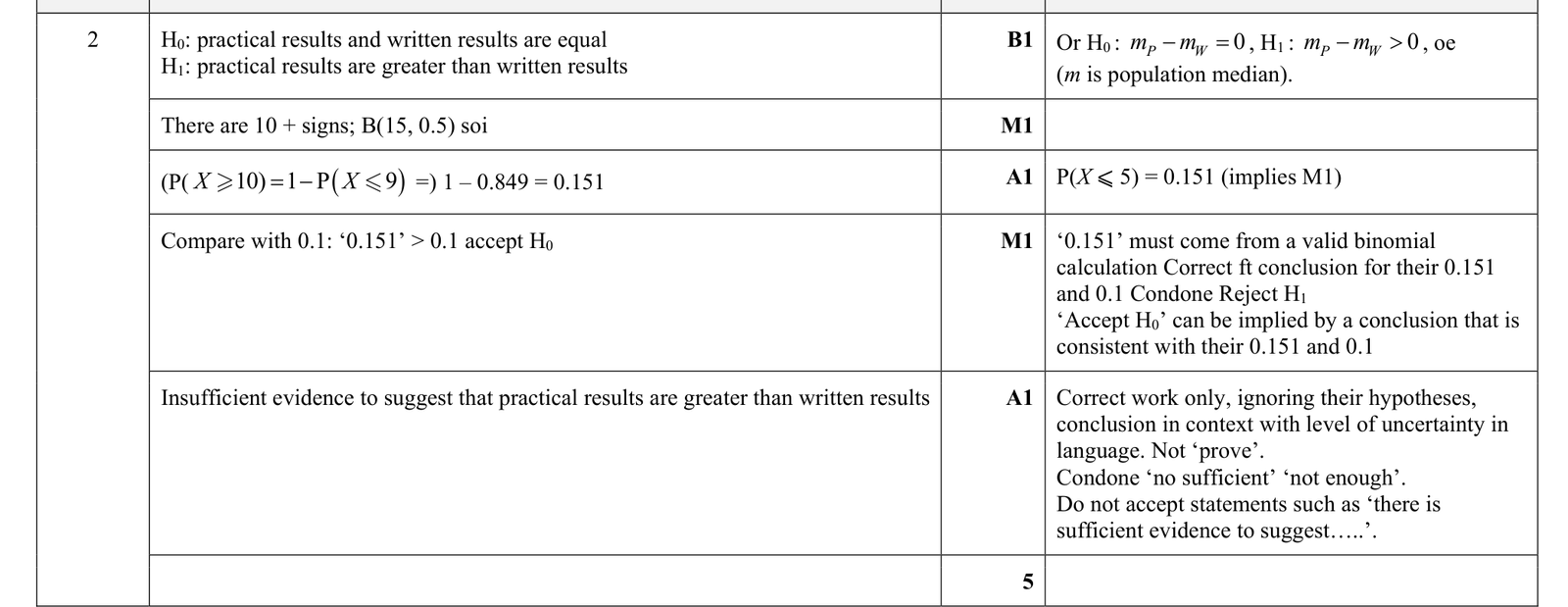
\(H_0\): the median difference is \(0\) (so practical and written marks are equally likely to be higher).
\(H_1\): the median difference is greater than \(0\) (practical marks tend to be higher).
From the data, there are \(10\) positive signs out of \(15\).
Under \(H_0\), \(X \sim \text{Bin}(15,0.5)\), where \(X\) is the number of positive signs.
\(p\text{-value}=P(X\ge 10)=0.151\).
Since \(0.151 \gt 0.10\), we do not reject \(H_0\).
There is insufficient evidence at the \(10\%\) level to suggest that, on average, the practical examination marks are higher than the written examination marks.
For a sign test, compare each student's practical mark with their written mark and record the sign of
\(\text{practical} - \text{written}\).
We test:
The question asks whether practical marks are higher on average, so this is a one-tailed test in the positive direction.
From the sample of \(15\) students, there are \(10\) positive differences, so the test statistic is \(X=10\).
If \(H_0\) is true, a positive sign and a negative sign are equally likely, so
\(X \sim \text{Bin}(15,0.5)\).
We need the probability of getting \(10\) or more positive signs:
\(P(X\ge 10)=1-P(X\le 9)\).
Using binomial probabilities,
\(P(X\ge 10)=0.151\) approximately.
This is the p-value for the test.
Now compare with the significance level \(0.10\):
\(0.151 \gt 0.10\).
So the result is not significant, and we do not reject \(H_0\).
Conclusion: there is not enough evidence at the \(10\%\) significance level to suggest that the practical examination marks are higher than the written examination marks.