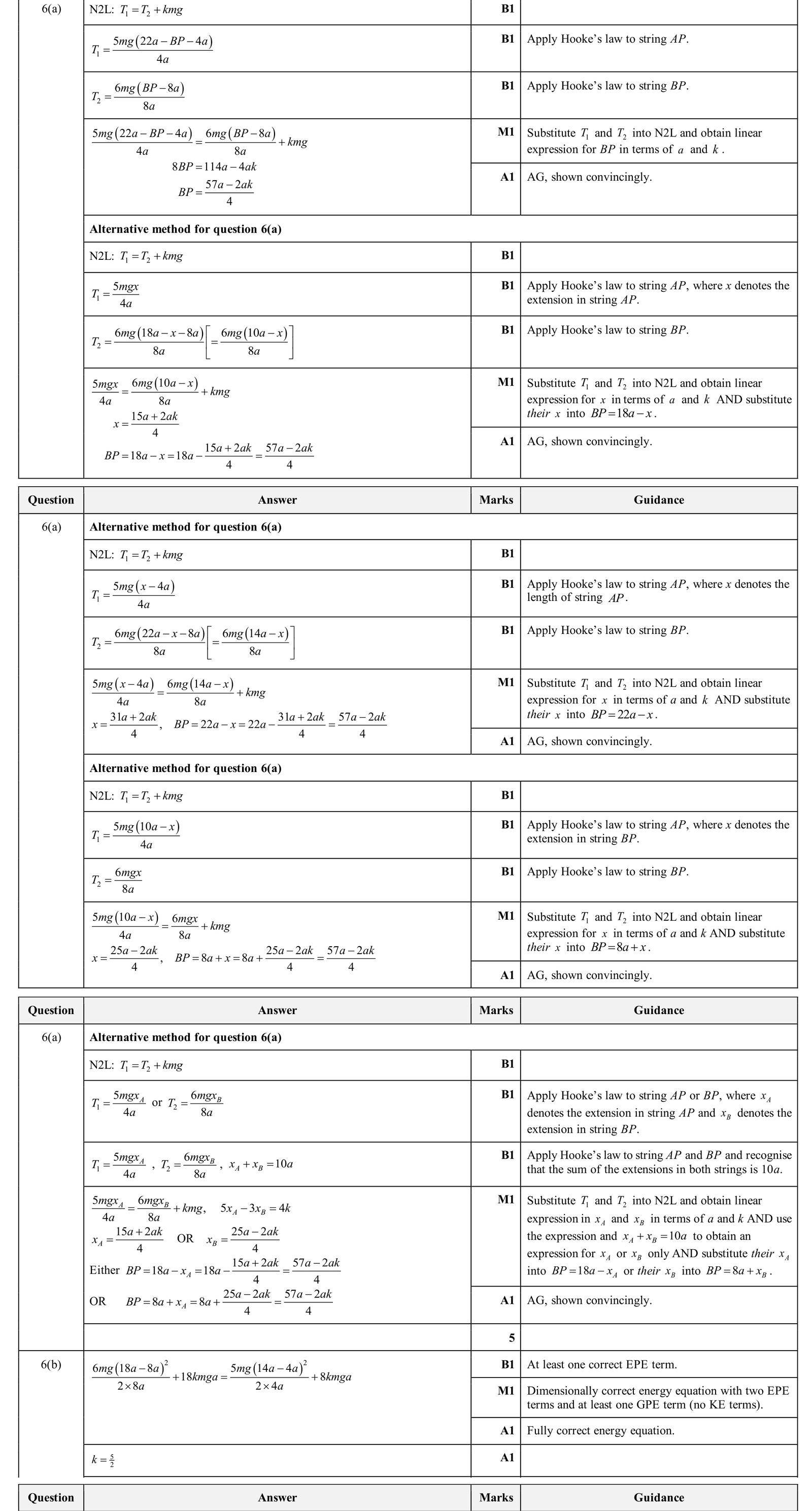
Answer:
(a)
\(BP=\frac{57a-2ak}{4}.\)
(b)
\(k=\frac52.\)
(a) Let
\(BP=y.\)
Then
\(AP=22a-y.\)
The extension of the upper string \(AP\) is
\((22a-y)-4a=18a-y.\)
So its tension is
\(T_1=\frac{5mg}{4a}(18a-y).\)
The extension of the lower string \(BP\) is
\(y-8a.\)
So its tension is
\(T_2=\frac{6mg}{8a}(y-8a).\)
In equilibrium, the upward tension in the upper string balances the downward tension in the lower string and the weight of \(P\), whose mass is \(km\). Hence
\(T_1=T_2+kmg.\)
Substitute the two tensions:
\(\frac{5mg}{4a}(18a-y)=\frac{6mg}{8a}(y-8a)+kmg.\)
Cancel \(mg\):
\(\frac{5(18a-y)}{4a}=\frac{6(y-8a)}{8a}+k.\)
Multiply by \(8a\):
\(10(18a-y)=6(y-8a)+8ak.\)
Thus
\(180a-10y=6y-48a+8ak.\)
So
\(228a-8ak=16y.\)
Therefore
\(y=\frac{228a-8ak}{16}=\frac{57a-2ak}{4}.\)
Hence
\(BP=\frac{57a-2ak}{4}.\)
(b) The particle is released from rest when \(BP=18a\). At this point,
\(AP=22a-18a=4a,\)
so the upper string has no extension. The lower string has extension
\(18a-8a=10a.\)
When the particle first comes to rest again, \(BP=8a\). At this point, the lower string has no extension, and
\(AP=22a-8a=14a.\)
So the upper string has extension
\(14a-4a=10a.\)
Use conservation of energy between the two rest positions.
Initial elastic potential energy is from the lower string:
\(\frac{6mg}{2(8a)}(10a)^2.\)
Final elastic potential energy is from the upper string:
\(\frac{5mg}{2(4a)}(10a)^2.\)
The initial gravitational potential energy is \(kmg(18a)\), and the final gravitational potential energy is \(kmg(8a)\). Hence
\(\frac{6mg(10a)^2}{16a}+18akmg =\frac{5mg(10a)^2}{8a}+8akmg.\)
Simplify:
\(\frac{600}{16}mga+18akmg =\frac{500}{8}mga+8akmg.\)
So
\(\frac{75}{2}mga+18akmg =\frac{125}{2}mga+8akmg.\)
Cancel \(mga\):
\(\frac{75}{2}+18k=\frac{125}{2}+8k.\)
Therefore
\(10k=25,\)
and so
\(k=\frac52.\)