9231 P31 - Nov 2025 - Q6 - 8 marks
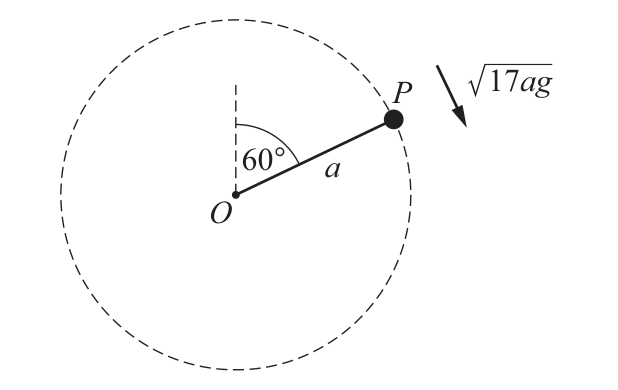
A particle \(P\) of mass \(m\) is attached to one end of a light inextensible string of length \(a\). The other end of the string is attached to a fixed point \(O\). Initially \(P\) is held with the string taut and making an angle of \(60^{\circ}\) with the upward vertical through \(O\). The particle \(P\) is projected perpendicular to the string in a downwards direction with speed \(\sqrt{17 a g}\). It then starts to move along a circular path in a vertical plane with centre \(O\) (see diagram). At the lowest point of its path, vertically below \(O\), the particle \(P\) collides with a stationary particle \(Q\). (a) Find, in terms of \(a\) and \(g\), an expression for the speed of \(P\) immediately before the collision with \(Q\).
As a result of the collision, \(P\) rebounds and moves back along a circular path with centre \(O\). The string becomes slack when \(P\) reaches the point on the circle vertically above \(O\). (b) Find, in terms of \(a\) and \(g\), an expression for the speed of \(P\) immediately after the collision with \(Q\).
The mass of particle \(Q\) is \(k m\) and the collision between \(P\) and \(Q\) is perfectly elastic. (c) Find the value of \(k\).