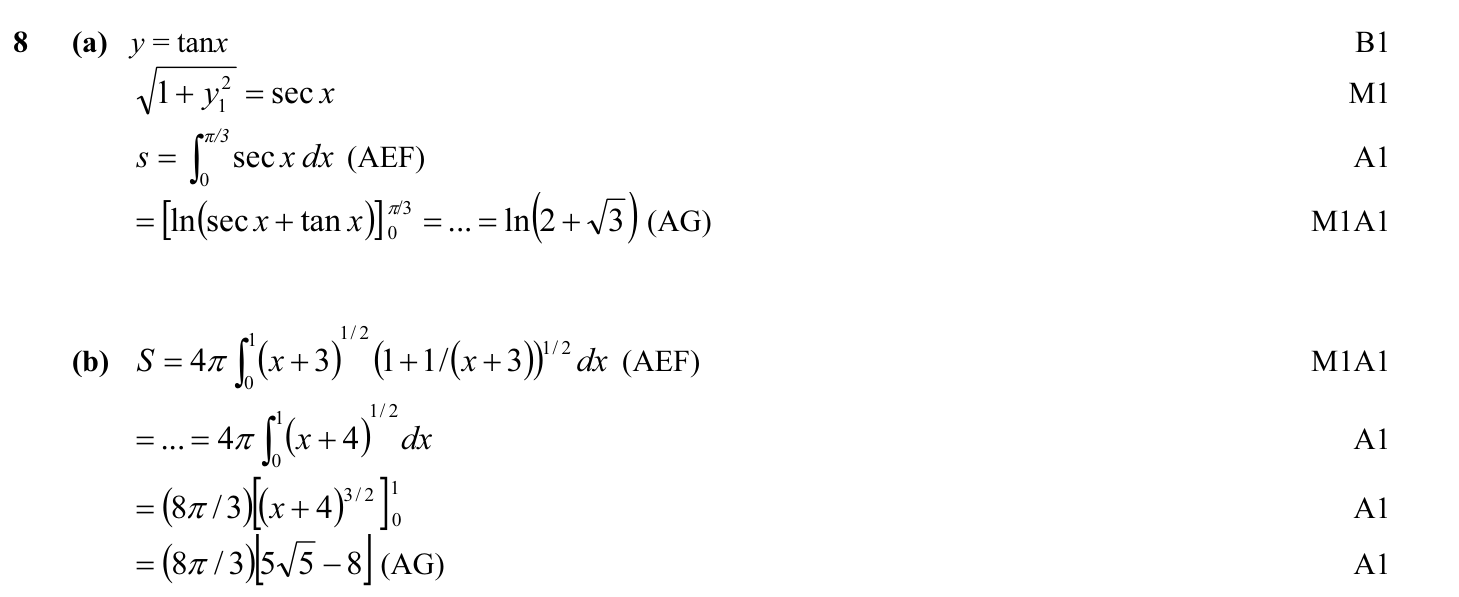
Answer: (a) The arc length is \(\int_a^b \sqrt{1+\left(\frac{dy}{dx}\right)^2}\,dx\). For \(y=-\ln(\cos x)\),
\(\frac{dy}{dx}=\tan x\), so \(\sqrt{1+\left(\frac{dy}{dx}\right)^2}=\sqrt{1+\tan^2 x}=\sec x\).
Hence
\(s=\int_0^{\pi/3} \sec x\,dx=[\ln(\sec x+\tan x)]_0^{\pi/3}=\ln(2+\sqrt3).\)
(b) The surface area formed by rotating a curve about the \(x\)-axis is \(S=2\pi\int_a^b y\sqrt{1+\left(\frac{dy}{dx}\right)^2}\,dx\).
Here \(y=2\sqrt{x+3}\), so \(\frac{dy}{dx}=\frac{1}{\sqrt{x+3}}\).
Therefore
\(S=2\pi\int_0^1 2\sqrt{x+3}\,\sqrt{1+\frac{1}{x+3}}\,dx=4\pi\int_0^1 \sqrt{x+3}\,\sqrt{\frac{x+4}{x+3}}\,dx.\)
This simplifies to
\(S=4\pi\int_0^1 \sqrt{x+4}\,dx.\)
Now
\(S=4\pi\left[\frac{2}{3}(x+4)^{3/2}\right]_0^1=\frac{8\pi}{3}\left(5^{3/2}-4^{3/2}\right).\)
So
\(S=\frac{8\pi}{3}(5\sqrt5-8).\)
(a)
To find the length of a curve \(y=f(x)\) from \(x=a\) to \(x=b\), use
\(s=\int_a^b \sqrt{1+\left(\frac{dy}{dx}\right)^2}\,dx.\)
Given \(y=-\ln(\cos x)\), differentiate:
\(\frac{dy}{dx}=-\frac{-\sin x}{\cos x}=\tan x.\)
So
\(\sqrt{1+\left(\frac{dy}{dx}\right)^2}=\sqrt{1+\tan^2 x}=\sec x.\)
Hence the arc length from \(x=0\) to \(x=\pi/3\) is
\(s=\int_0^{\pi/3} \sec x\,dx.\)
Using \(\int \sec x\,dx=\ln|\sec x+\tan x|+C\),
\(s=[\ln(\sec x+\tan x)]_0^{\pi/3}.\)
Now \(\sec(\pi/3)=2\) and \(\tan(\pi/3)=\sqrt3\), while at \(x=0\), \(\sec 0=1\) and \(\tan 0=0\). So
\(s=\ln(2+\sqrt3)-\ln(1)=\ln(2+\sqrt3).\)
(b)
For rotation about the \(x\)-axis, the surface area is
\(S=2\pi\int_a^b y\sqrt{1+\left(\frac{dy}{dx}\right)^2}\,dx.\)
Here \(y=2\sqrt{x+3}=2(x+3)^{1/2}\), so
\(\frac{dy}{dx}=2\cdot\frac12(x+3)^{-1/2}=\frac{1}{\sqrt{x+3}}.\)
Therefore
\(S=2\pi\int_0^1 2\sqrt{x+3}\,\sqrt{1+\frac{1}{x+3}}\,dx.\)
Simplify the square root:
\(1+\frac{1}{x+3}=\frac{x+4}{x+3},\)
so
\(\sqrt{x+3}\,\sqrt{1+\frac{1}{x+3}}=\sqrt{x+3}\,\sqrt{\frac{x+4}{x+3}}=\sqrt{x+4}.\)
Thus
\(S=4\pi\int_0^1 \sqrt{x+4}\,dx.\)
Integrating,
\(\int \sqrt{x+4}\,dx=\int (x+4)^{1/2}\,dx=\frac{2}{3}(x+4)^{3/2}.\)
So
\(S=4\pi\left[\frac{2}{3}(x+4)^{3/2}\right]_0^1=\frac{8\pi}{3}\left(5^{3/2}-4^{3/2}\right).\)
Now \(5^{3/2}=5\sqrt5\) and \(4^{3/2}=8\), giving
\(S=\frac{8\pi}{3}(5\sqrt5-8).\)