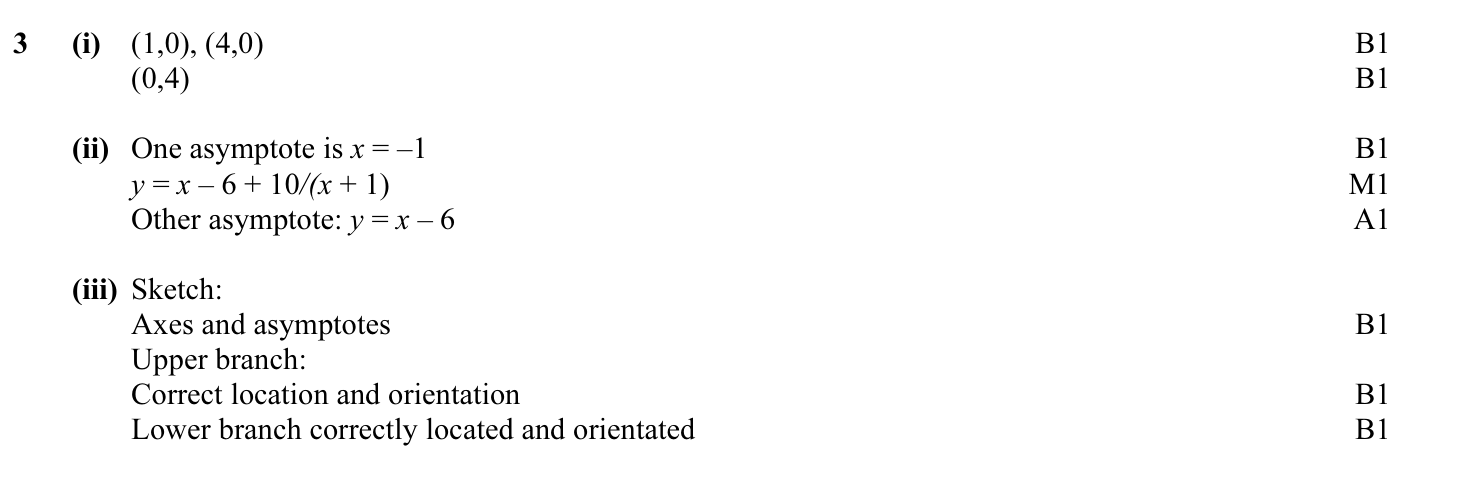
Answer: (i) The curve meets the x-axis where \(y=0\):
\(\frac{x^{2}-5x+4}{x+1}=0\Rightarrow x^{2}-5x+4=0\).
Factorising gives \((x-1)(x-4)=0\), so \(x=1\) or \(x=4\).
Hence the x-intercepts are \((1,0)\) and \((4,0)\).
To find the y-intercept, set \(x=0\):
\(y=\frac{0-0+4}{0+1}=4\).
So the y-intercept is \((0,4)\).
(ii) The denominator is zero when \(x+1=0\), so one asymptote is \(x=-1\).
For the oblique asymptote, divide \(x^{2}-5x+4\) by \(x+1\):
\(x^{2}-5x+4=(x+1)(x-6)+10\).
So
\(y=x-6+\frac{10}{x+1}\).
As \(x\to\pm\infty\), the fraction tends to \(0\), so the other asymptote is \(y=x-6\).
(iii) The sketch should show the vertical asymptote \(x=-1\) and the sloping asymptote \(y=x-6\), with the curve crossing the axes at \((1,0)\), \((4,0)\), and \((0,4)\). For \(x\gt -1\), \(\frac{10}{x+1}\gt 0\), so the curve lies above \(y=x-6\), goes to \(+\infty\) as \(x\to-1^+\), and then approaches the sloping asymptote as \(x\) increases. For \(x\lt -1\), \(\frac{10}{x+1}\lt 0\), so the left-hand branch lies below \(y=x-6\), approaches \(-\infty\) as \(x\to-1^-\), and tends to the sloping asymptote as \(x\to-\infty\).
(i) Intercepts with the axes:
For x-intercepts, set \(y=0\):
\(\frac{x^{2}-5x+4}{x+1}=0\).
A fraction is zero when its numerator is zero, so solve
\(x^{2}-5x+4=0\).
Factorising:
\((x-1)(x-4)=0\).
So \(x=1\) or \(x=4\), giving the points \((1,0)\) and \((4,0)\).
For the y-intercept, set \(x=0\):
\(y=\frac{0^{2}-5(0)+4}{0+1}=4\).
So the y-intercept is \((0,4)\).
(ii) Asymptotes:
The vertical asymptote occurs when the denominator is zero:
\(x+1=0 \Rightarrow x=-1\).
To find the sloping asymptote, divide \(x^{2}-5x+4\) by \(x+1\):
\(x^{2}-5x+4=(x+1)(x-6)+10\).
Hence
\(y=\frac{x^{2}-5x+4}{x+1}=x-6+\frac{10}{x+1}\).
As \(x\to\pm\infty\), the term \(\frac{10}{x+1}\to 0\), so the other asymptote is
\(y=x-6\).
(iii) Sketch:
Draw the axes, then the asymptotes \(x=-1\) and \(y=x-6\).
Plot the intercepts \((1,0)\), \((4,0)\), and \((0,4)\).
Use the form \(y=x-6+\frac{10}{x+1}\) to determine the branches:
- For \(x\gt -1\), \(\frac{10}{x+1}\gt 0\), so the curve lies above the line \(y=x-6\) and rises to \(+\infty\) as \(x\to-1^+\).
- For \(x\lt -1\), \(\frac{10}{x+1}\lt 0\), so the curve lies below the line \(y=x-6\) and falls to \(-\infty\) as \(x\to-1^-\).
The right-hand branch passes through \((0,4)\), crosses the x-axis at \((1,0)\) and \((4,0)\), and then approaches the line \(y=x-6\). The left-hand branch is below the sloping asymptote and approaches it as \(x\to-\infty\).