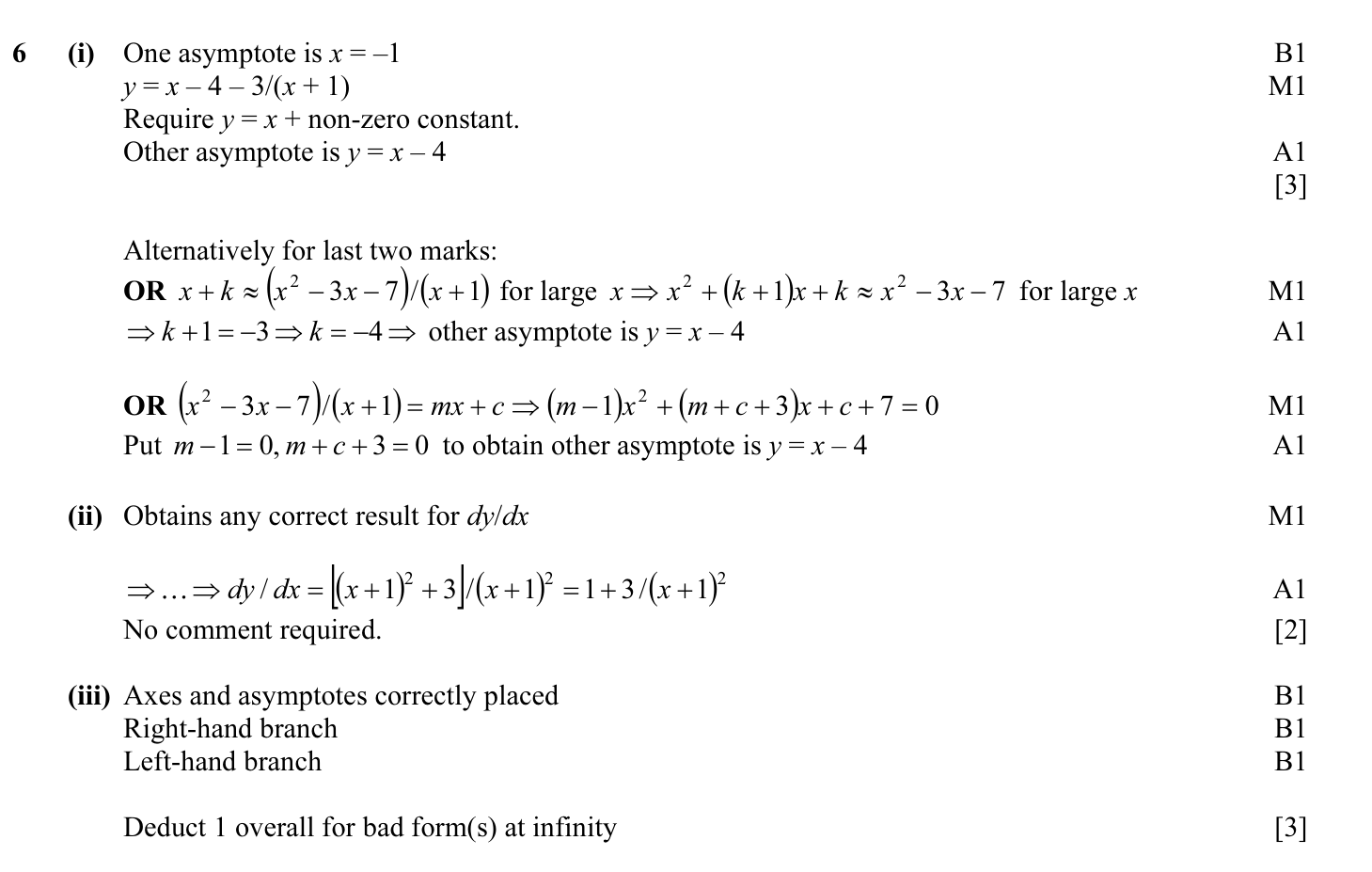
Answer: (a) The asymptotes are \(x=-1\) and \(y=x-4\).
(b) \(\dfrac{dy}{dx}=1+\dfrac{3}{(x+1)^2}\), so \(\dfrac{dy}{dx}\gt 1\) for all points on \(C\).
(c) The sketch has a vertical asymptote at \(x=-1\) and an oblique asymptote \(y=x-4\). The curve has two branches, one on each side of \(x=-1\), and both branches lie above the line \(y=x-4\). As \(x\to -1^-\), \(y\to +\infty\); as \(x\to -1^+\), \(y\to -\infty\). For large \(|x|\), the curve approaches \(y=x-4\).
(a) First rewrite the function by dividing the numerator by \(x+1\):
\(\frac{x^2-3x-7}{x+1}=x-4-\frac{3}{x+1}.\)
From this form, it is clear that \(x=-1\) is a vertical asymptote, since the denominator becomes zero there.
As \(x\to\pm\infty\), the term \(-\dfrac{3}{x+1}\to 0\), so the curve approaches the straight line \(y=x-4\). Hence the oblique asymptote is \(y=x-4\).
(b) Differentiate using the rewritten form:
\(y=x-4-\frac{3}{x+1}.\)
So
\(\frac{dy}{dx}=1-3\frac{d}{dx}\big((x+1)^{-1}\big)=1+\frac{3}{(x+1)^2}.\)
Now \((x+1)^2\gt 0\) for all \(x\neq -1\), so \(\dfrac{3}{(x+1)^2}\gt 0\). Therefore
\(\frac{dy}{dx}=1+\frac{3}{(x+1)^2}\gt 1\)
at every point of the curve.
(c) For the sketch, use the asymptotes and the behaviour near them.
- The vertical asymptote is \(x=-1\).
- The oblique asymptote is \(y=x-4\).
- Since \(y-(x-4)=-\dfrac{3}{x+1}\), the curve is above the line \(y=x-4\) when \(x\lt -1\), and below it when \(x\gt -1\).
- As \(x\to -1^-\), \(x+1\to 0^-\), so \(-\dfrac{3}{x+1}\to +\infty\), hence \(y\to +\infty\).
- As \(x\to -1^+\), \(x+1\to 0^+\), so \(-\dfrac{3}{x+1}\to -\infty\), hence \(y\to -\infty\).
- Because \(\dfrac{dy}{dx}\gt 1\), the curve is increasing throughout each branch.
The left-hand branch lies above \(y=x-4\) and rises to \(+\infty\) near \(x=-1\). The right-hand branch lies below \(y=x-4\) and falls to \(-\infty\) near \(x=-1\), then rises with slope greater than 1 as \(x\) increases.