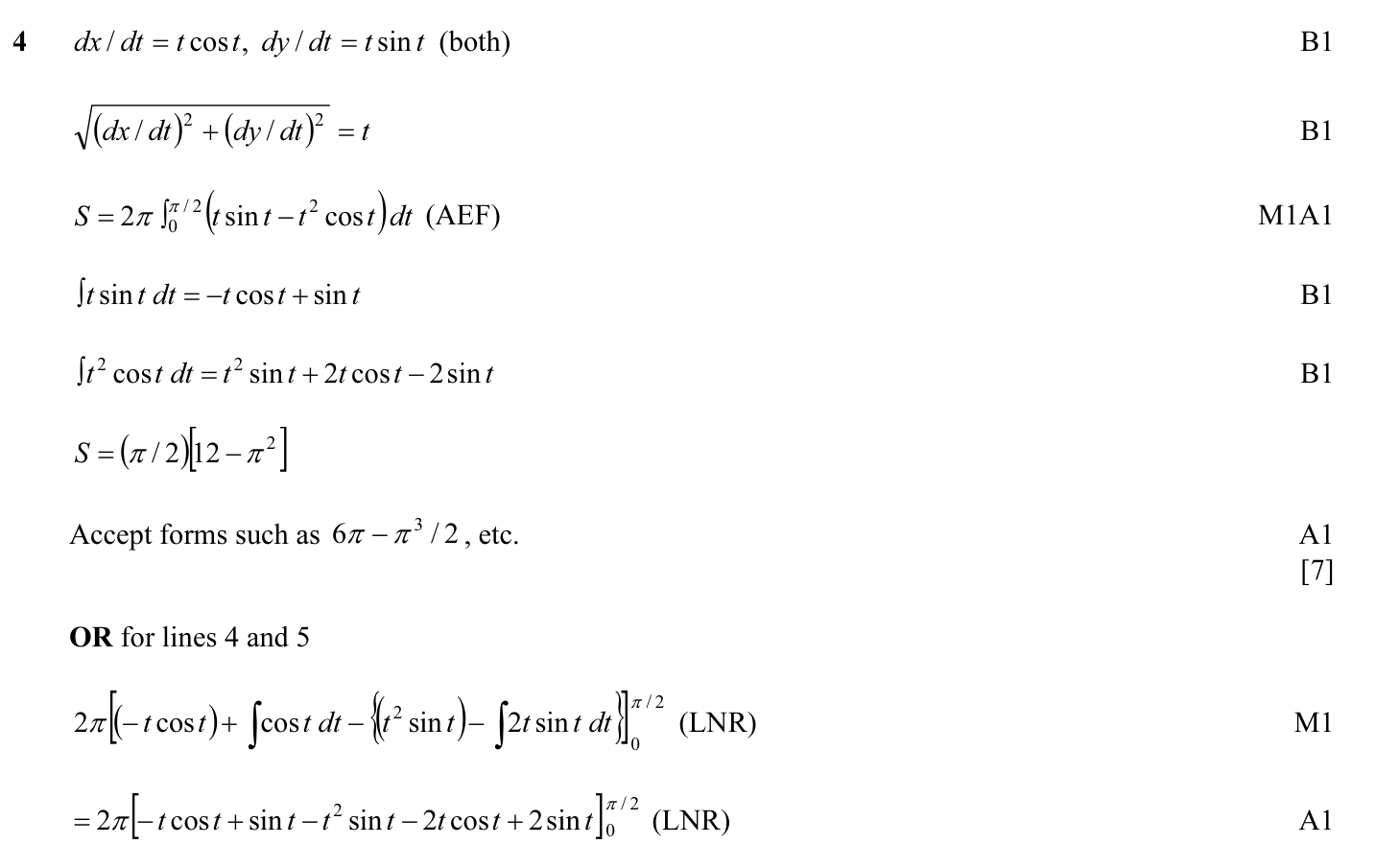
Answer: The surface area is \(6\pi-\frac{\pi^3}{2}\).
For a parametric curve rotated about the \(x\)-axis, the surface area is
\(S=2\pi\int y\,\frac{ds}{dt}\,dt\), where \(\frac{ds}{dt}=\sqrt{\left(\frac{dx}{dt}\right)^2+\left(\frac{dy}{dt}\right)^2}\).
Differentiate the parametric equations:
\(x=\cos t+t\sin t\) so \(\frac{dx}{dt}=-\sin t+\sin t+t\cos t=t\cos t\).
\(y=\sin t-t\cos t\) so \(\frac{dy}{dt}=\cos t-(\cos t-t\sin t)=t\sin t\).
Hence
\(\frac{ds}{dt}=\sqrt{(t\cos t)^2+(t\sin t)^2}=\sqrt{t^2(\cos^2 t+\sin^2 t)}=t\), for \(0\le t\le \frac{\pi}{2}\).
Now substitute into the surface area formula:
\(S=2\pi\int_0^{\pi/2} (\sin t-t\cos t)\,t\,dt=2\pi\int_0^{\pi/2}(t\sin t-t^2\cos t)\,dt\).
Evaluate each integral separately.
For \(\int t\sin t\,dt\), integration by parts gives
\(\int t\sin t\,dt=-t\cos t+\sin t\).
For \(\int t^2\cos t\,dt\), integration by parts twice gives
\(\int t^2\cos t\,dt=t^2\sin t+2t\cos t-2\sin t\).
So
\(S=2\pi\left[\left(-t\cos t+\sin t\right)-\left(t^2\sin t+2t\cos t-2\sin t\right)\right]_0^{\pi/2}\).
This simplifies to
\(S=2\pi\left[-3t\cos t- t^2\sin t+3\sin t\right]_0^{\pi/2}\).
At \(t=\frac{\pi}{2}\), this is
\(2\pi\left(0-\frac{\pi^2}{4}+3\right)\).
At \(t=0\), it is \(0\).
Therefore
\(S=2\pi\left(3-\frac{\pi^2}{4}\right)=6\pi-\frac{\pi^3}{2}\).