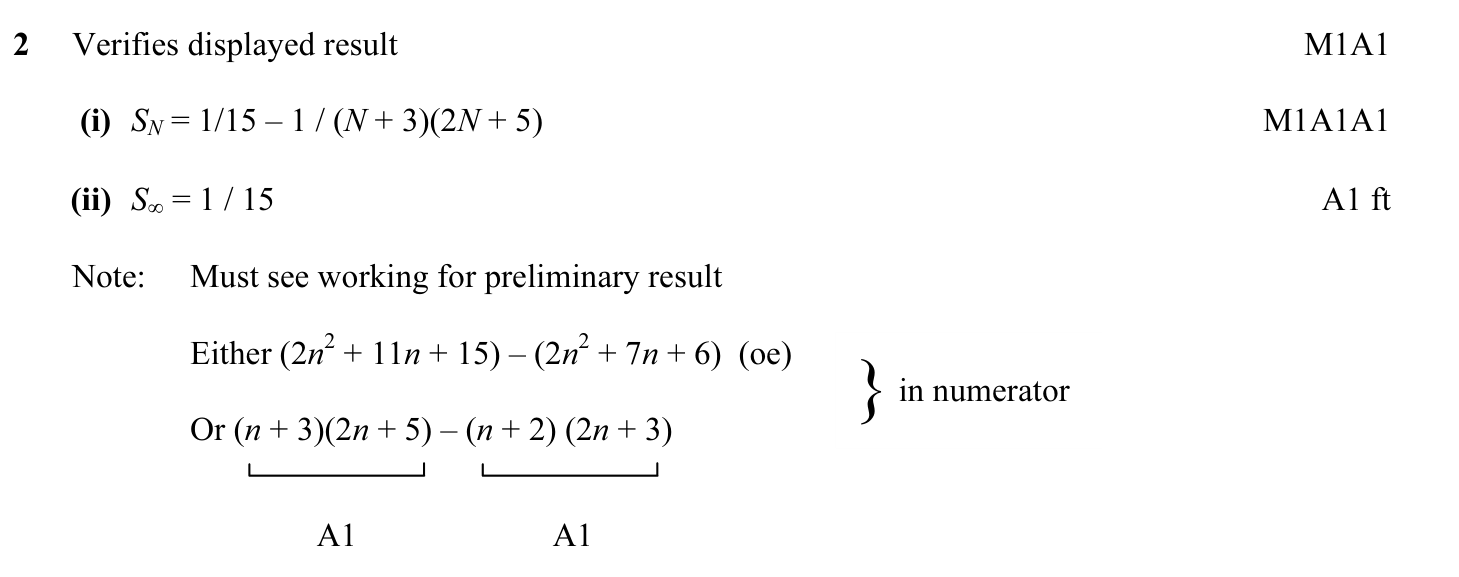
Answer: (i) The series telescopes, so the sum to \(N\) terms is
\(S_N=\frac{1}{15}-\frac{1}{(N+3)(2N+5)}\).
(ii) As \(N\to\infty\), \(\frac{1}{(N+3)(2N+5)}\to 0\), so
\(S_\infty=\frac{1}{15}\).
First rewrite the general term in a telescoping form:
\(\frac{1}{(n+2)(2n+3)}-\frac{1}{(n+3)(2n+5)}\)
Bring the two fractions together:
\(=\frac{(n+3)(2n+5)-(n+2)(2n+3)}{(n+2)(n+3)(2n+3)(2n+5)}\).
Now expand the numerator:
\((n+3)(2n+5)=2n^2+11n+15\),
\((n+2)(2n+3)=2n^2+7n+6\).
So the numerator becomes
\((2n^2+11n+15)-(2n^2+7n+6)=4n+9\).
Hence
\(\frac{1}{(n+2)(2n+3)}-\frac{1}{(n+3)(2n+5)}=\frac{4n+9}{(n+2)(n+3)(2n+3)(2n+5)}\),
as required.
Now consider
\(S_N=\sum_{n=1}^{N}\frac{4n+9}{(n+2)(n+3)(2n+3)(2n+5)}\).
Using the identity above,
\(S_N=\sum_{n=1}^{N}\left(\frac{1}{(n+2)(2n+3)}-\frac{1}{(n+3)(2n+5)}\right)\).
Write out the first few terms:
\(S_N=\left(\frac{1}{3\cdot 5}-\frac{1}{4\cdot 7}\right)+\left(\frac{1}{4\cdot 7}-\frac{1}{5\cdot 9}\right)+\cdots+\left(\frac{1}{(N+2)(2N+3)}-\frac{1}{(N+3)(2N+5)}\right).\)
Everything in the middle cancels, leaving
\(S_N=\frac{1}{3\cdot 5}-\frac{1}{(N+3)(2N+5)}=\frac{1}{15}-\frac{1}{(N+3)(2N+5)}\).
So
\(\boxed{S_N=\frac{1}{15}-\frac{1}{(N+3)(2N+5)}}\).
For the sum to infinity, let \(N\to\infty\):
\(\frac{1}{(N+3)(2N+5)}\to 0\),
therefore
\(\boxed{S_\infty=\frac{1}{15}}\).