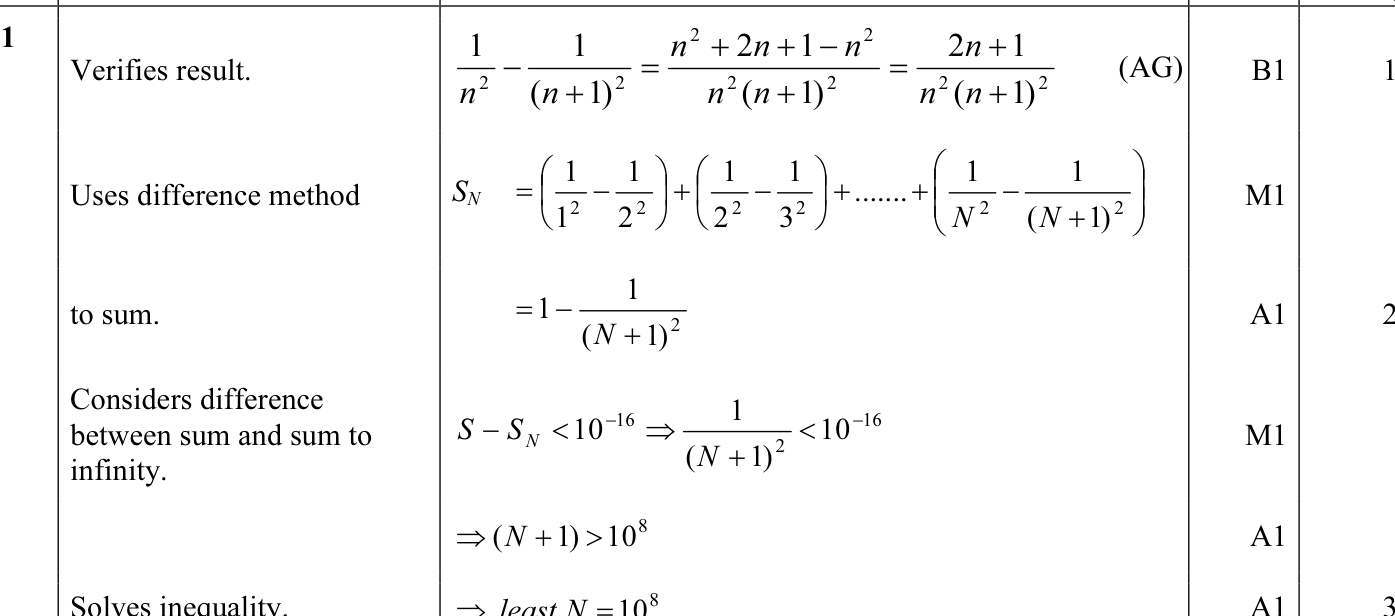
Answer: The sum telescopes, so \(S_N = 1 - \frac{1}{(N+1)^2}\).
Also, \(S=1\), so \(S-S_N=\frac{1}{(N+1)^2}\).
For \(S-S_N\lt 10^{-16}\), we need \(\frac{1}{(N+1)^2}\lt 10^{-16}\), hence \(N+1\gt 10^8\). Therefore the least value of \(N\) is \(10^8\).
First verify the given identity:
\(\frac{1}{n^2}-\frac{1}{(n+1)^2}=\frac{(n+1)^2-n^2}{n^2(n+1)^2}=\frac{n^2+2n+1-n^2}{n^2(n+1)^2}=\frac{2n+1}{n^2(n+1)^2}.\)
So each term of the sum can be written as a difference:
\(\frac{2r+1}{r^2(r+1)^2}=\frac{1}{r^2}-\frac{1}{(r+1)^2}.\)
Hence
\(S_N=\sum_{r=1}^N \left(\frac{1}{r^2}-\frac{1}{(r+1)^2}\right).\)
Writing out the first few terms shows the cancellation:
\(S_N=\left(1-\frac{1}{2^2}\right)+\left(\frac{1}{2^2}-\frac{1}{3^2}\right)+\cdots+\left(\frac{1}{N^2}-\frac{1}{(N+1)^2}\right).\)
All the intermediate terms cancel, leaving
\(S_N=1-\frac{1}{(N+1)^2}.\)
Now let \(S=\lim_{N\to\infty} S_N\). Since \(\frac{1}{(N+1)^2}\to 0\), we get \(S=1\).
Therefore
\(S-S_N=1-\left(1-\frac{1}{(N+1)^2}\right)=\frac{1}{(N+1)^2}.\)
We want
\(\frac{1}{(N+1)^2}\lt 10^{-16}.\)
Taking square roots gives
\(N+1\gt 10^8.\)
So the least integer value of \(N\) is \(10^8\).