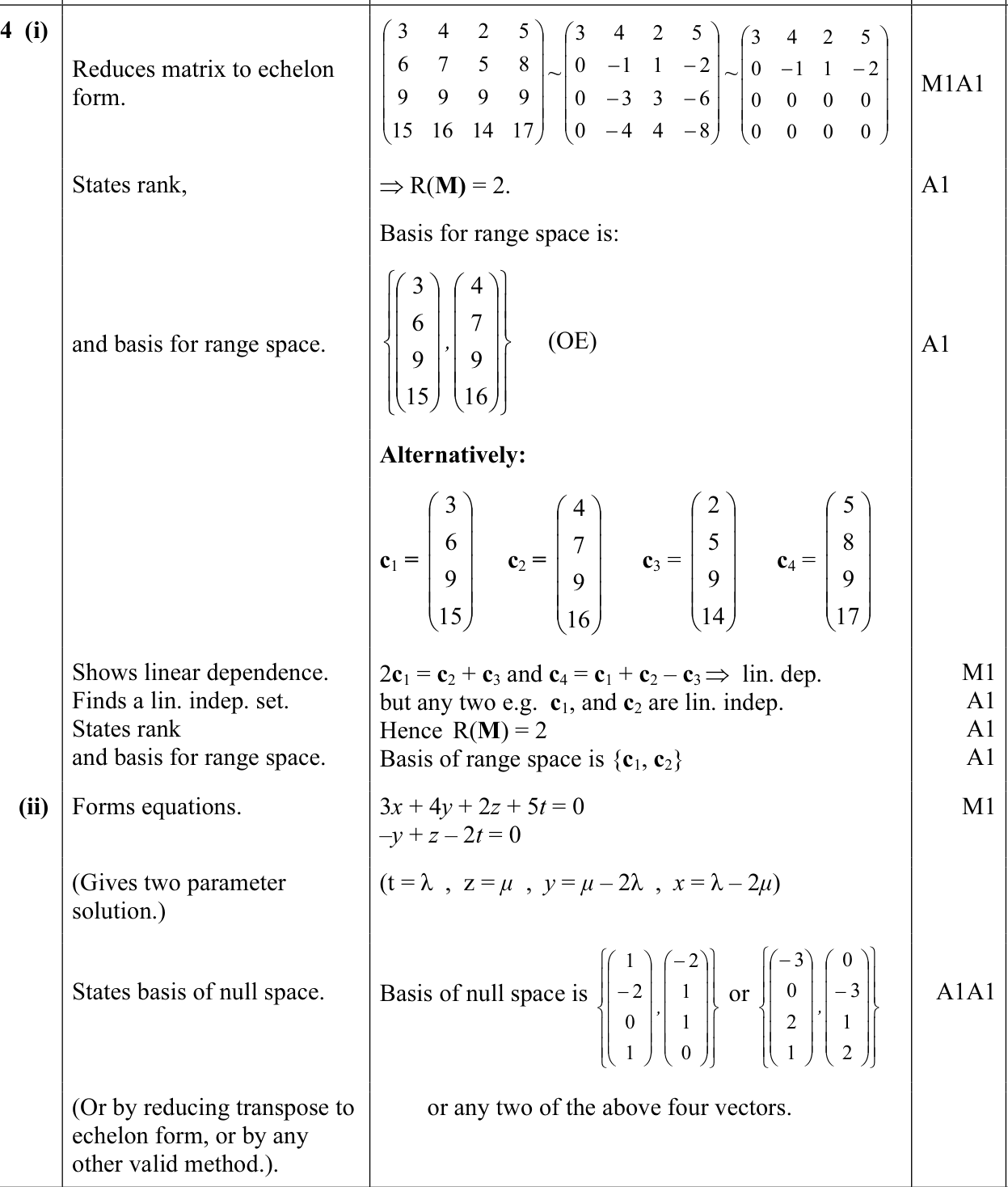
Answer: (i) The rank of \(\mathbf{M}\) is \(2\). A basis for the range space is given by the first two columns of \(\mathbf{M}\): \(\left\{\begin{pmatrix}3\\6\\9\\15\end{pmatrix},\begin{pmatrix}4\\7\\9\\16\end{pmatrix}\right\}\).
(ii) A basis for the null space is \(\left\{\begin{pmatrix}1\\-2\\0\\1\end{pmatrix},\begin{pmatrix}-2\\1\\1\\0\end{pmatrix}\right\}\).
(i) To find the rank, reduce \(\mathbf{M}\) to echelon form.
Starting with
\(\mathbf{M}=\begin{pmatrix}3 & 4 & 2 & 5 \\ 6 & 7 & 5 & 8 \\ 9 & 9 & 9 & 9 \\ 15 & 16 & 14 & 17\end{pmatrix}\),
subtract suitable multiples of the first row from the others:
\(R_2\leftarrow R_2-2R_1\), \(R_3\leftarrow R_3-3R_1\), \(R_4\leftarrow R_4-5R_1\), giving
\(\begin{pmatrix}3 & 4 & 2 & 5 \\ 0 & -1 & 1 & -2 \\ 0 & -3 & 3 & -6 \\ 0 & -4 & 4 & -8\end{pmatrix}.\)
Now use the second row to eliminate the entries below it:
\(R_3\leftarrow R_3-3R_2\) and \(R_4\leftarrow R_4-4R_2\), so
\(\begin{pmatrix}3 & 4 & 2 & 5 \\ 0 & -1 & 1 & -2 \\ 0 & 0 & 0 & 0 \\ 0 & 0 & 0 & 0\end{pmatrix}.\)
There are two non-zero rows, so the rank is \(2\).
A basis for the range space is given by the pivot columns of the original matrix, namely the first and second columns:
\(\left\{\begin{pmatrix}3\\6\\9\\15\end{pmatrix},\begin{pmatrix}4\\7\\9\\16\end{pmatrix}\right\}.\)
(ii) A vector \(\begin{pmatrix}x\\y\\z\\t\end{pmatrix}\) lies in the null space if \(\mathbf{M}\begin{pmatrix}x\\y\\z\\t\end{pmatrix}=\mathbf{0}\). Using the echelon form, this gives the equations
\(3x+4y+2z+5t=0\),
\(-y+z-2t=0\).
From \(-y+z-2t=0\), we get \(y=z-2t\).
Substitute into the first equation:
\(3x+4(z-2t)+2z+5t=0\), so \(3x+6z-3t=0\), hence \(x=-2z+t\).
Let \(z=s\) and \(t=u\). Then
\(\begin{pmatrix}x\\y\\z\\t\end{pmatrix}=\begin{pmatrix}-2s+u\\s-2u\\s\\u\end{pmatrix}=s\begin{pmatrix}-2\\1\\1\\0\end{pmatrix}+u\begin{pmatrix}1\\-2\\0\\1\end{pmatrix}.\)
So a basis for the null space is \(\left\{\begin{pmatrix}1\\-2\\0\\1\end{pmatrix},\begin{pmatrix}-2\\1\\1\\0\end{pmatrix}\right\}\).