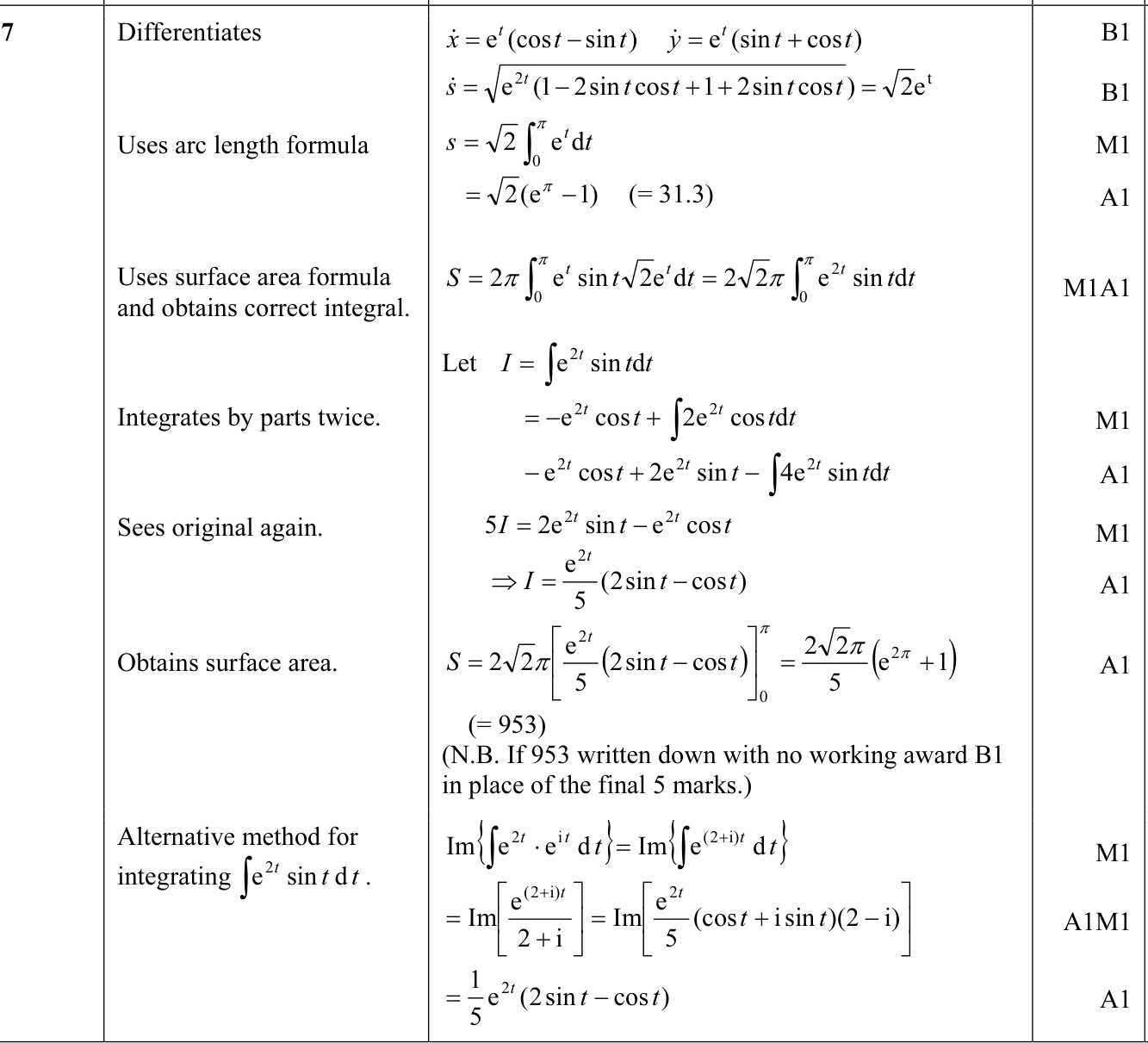
Answer: The arc length is \(l = \sqrt{2}\,(e^{\pi}-1)\).
The surface area generated when \(C\) is rotated about the \(x\)-axis is \(\\displaystyle \frac{2\sqrt{2}\pi}{5}\left(e^{2\pi}+1\right)\).
For the parametric curve \(x=e^t\cos t\), \(y=e^t\sin t\), \(0\le t\le \pi\), first find \(\frac{dx}{dt}\) and \(\frac{dy}{dt}\):
\(\frac{dx}{dt}=e^t(\cos t-\sin t)\), \(\frac{dy}{dt}=e^t(\sin t+\cos t)\).
The speed is
\(\sqrt{\left(\frac{dx}{dt}\right)^2+\left(\frac{dy}{dt}\right)^2}=\sqrt{e^{2t}(\cos t-\sin t)^2+e^{2t}(\sin t+\cos t)^2}\).
Simplifying inside the square root gives
\((\cos t-\sin t)^2+(\sin t+\cos t)^2=2(\sin^2 t+\cos^2 t)=2\),
so
\(\frac{ds}{dt}=\sqrt{2}\,e^t\).
Hence the arc length is
\(l=\int_0^{\pi}\sqrt{2}\,e^t\,dt=\sqrt{2}\,[e^t]_0^{\pi}=\sqrt{2}(e^{\pi}-1).\)
For the surface area when the curve is rotated about the \(x\)-axis, use
\(S=2\pi\int_0^{\pi} y\,\frac{ds}{dt}\,dt.\)
Substituting \(y=e^t\sin t\) and \(\frac{ds}{dt}=\sqrt{2}e^t\),
\(S=2\pi\int_0^{\pi} e^t\sin t\cdot \sqrt{2}e^t\,dt=2\sqrt{2}\pi\int_0^{\pi} e^{2t}\sin t\,dt.\)
Now evaluate \(I=\int e^{2t}\sin t\,dt\) by integration by parts twice.
Take \(u=\sin t\), \(dv=e^{2t}dt\). Then \(du=\cos t\,dt\), \(v=\frac12 e^{2t}\), so
\(I=\frac12 e^{2t}\sin t-\frac12\int e^{2t}\cos t\,dt.\)
Let \(J=\int e^{2t}\cos t\,dt\). Again by parts, with \(u=\cos t\), \(dv=e^{2t}dt\),
\(J=\frac12 e^{2t}\cos t+\frac12\int e^{2t}\sin t\,dt=\frac12 e^{2t}\cos t+\frac12 I.\)
So
\(I=\frac12 e^{2t}\sin t-\frac12\left(\frac12 e^{2t}\cos t+\frac12 I\right).\)
Therefore
\(I=\frac12 e^{2t}\sin t-\frac14 e^{2t}\cos t-\frac14 I\),
hence \(\frac54 I=e^{2t}\left(\frac12\sin t-\frac14\cos t\right)\), giving
\(I=\frac{e^{2t}}{5}(2\sin t-\cos t)+C.\)
Thus
\(S=2\sqrt{2}\pi\left[\frac{e^{2t}}{5}(2\sin t-\cos t)\right]_0^{\pi}.\)
At \(t=\pi\), this is \(\frac{e^{2\pi}}{5}(0-(-1))=\frac{e^{2\pi}}{5}\); at \(t=0\), it is \(-\frac15\). Therefore
\(S=2\sqrt{2}\pi\left(\frac{e^{2\pi}+1}{5}\right)=\frac{2\sqrt{2}\pi}{5}(e^{2\pi}+1).\)