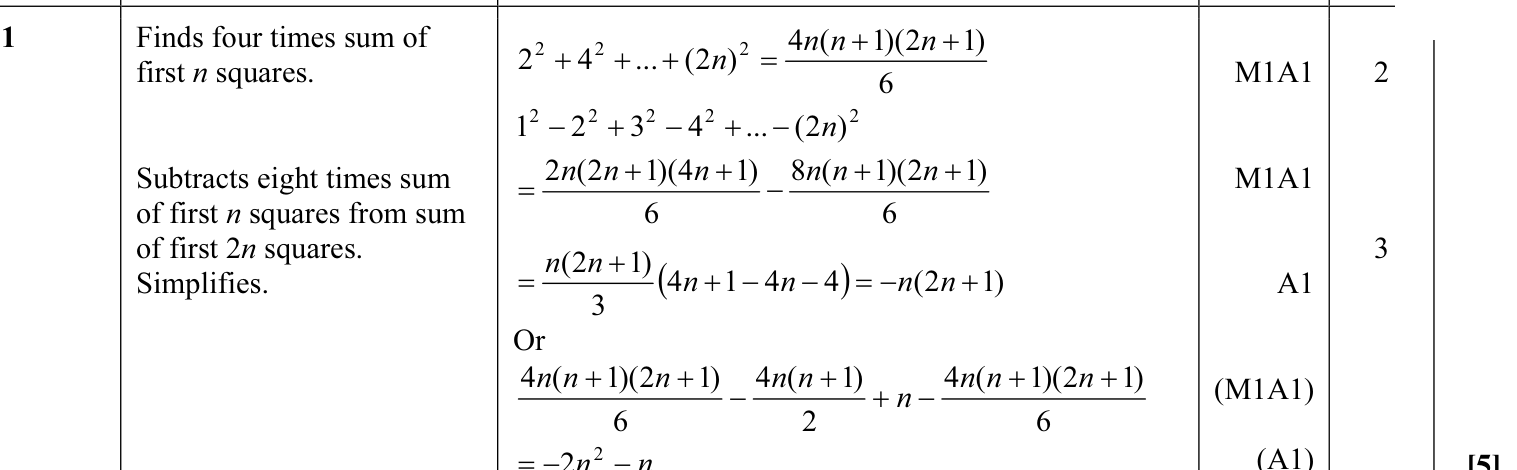
Answer: (a) \(2^{2}+4^{2}+\ldots+(2n)^{2}=4(1^{2}+2^{2}+\ldots+n^{2})\).
Using \(1^{2}+2^{2}+\ldots+n^{2}=\frac{n(n+1)(2n+1)}{6}\), we get
\(2^{2}+4^{2}+\ldots+(2n)^{2}=4\cdot \frac{n(n+1)(2n+1)}{6}=\frac{2n(n+1)(2n+1)}{3}.\)
(b) \(1^{2}-2^{2}+3^{2}-4^{2}+\ldots-(2n)^{2}\)
\(=(1^{2}+3^{2}+\ldots+(2n-1)^{2})-(2^{2}+4^{2}+\ldots+(2n)^{2}).\)
Now
\(1^{2}+3^{2}+\ldots+(2n-1)^{2}=(1^{2}+2^{2}+\ldots+(2n)^{2})-(2^{2}+4^{2}+\ldots+(2n)^{2}).\)
So
\(1^{2}-2^{2}+3^{2}-4^{2}+\ldots-(2n)^{2}=(1^{2}+2^{2}+\ldots+(2n)^{2})-2(2^{2}+4^{2}+\ldots+(2n)^{2}).\)
Substitute the two sums:
\(=\frac{2n(2n+1)(4n+1)}{6}-2\cdot \frac{2n(n+1)(2n+1)}{3}.\)
Simplifying gives
\(=\frac{n(2n+1)}{3}\big((4n+1)-4(n+1)\big)=-n(2n+1).\)
Hence \(1^{2}-2^{2}+3^{2}-4^{2}+\ldots-(2n)^{2}=-n(2n+1)=-2n^{2}-n.\)
(a) Write the required sum as a multiple of the sum of the first \(n\) squares:
\(2^{2}+4^{2}+\ldots+(2n)^{2}=4(1^{2}+2^{2}+\ldots+n^{2}).\)
Using \(1^{2}+2^{2}+\ldots+n^{2}=\frac{n(n+1)(2n+1)}{6}\),
\(2^{2}+4^{2}+\ldots+(2n)^{2}=4\cdot \frac{n(n+1)(2n+1)}{6}=\frac{2n(n+1)(2n+1)}{3}.\)
(b) Let
\(S=1^{2}-2^{2}+3^{2}-4^{2}+\ldots-(2n)^{2}.\)
Group the odd and even squares:
\(S=(1^{2}+3^{2}+\ldots+(2n-1)^{2})-(2^{2}+4^{2}+\ldots+(2n)^{2}).\)
Also, the odd squares can be found from the sum of all squares minus the even squares:
\(1^{2}+3^{2}+\ldots+(2n-1)^{2}=(1^{2}+2^{2}+\ldots+(2n)^{2})-(2^{2}+4^{2}+\ldots+(2n)^{2}).\)
So
\(S=(1^{2}+2^{2}+\ldots+(2n)^{2})-2(2^{2}+4^{2}+\ldots+(2n)^{2}).\)
Now
\(1^{2}+2^{2}+\ldots+(2n)^{2}=\frac{2n(2n+1)(4n+1)}{6}\)
and from part (a)
\(2^{2}+4^{2}+\ldots+(2n)^{2}=\frac{2n(n+1)(2n+1)}{3}.\)
Hence
\(S=\frac{2n(2n+1)(4n+1)}{6}-2\cdot \frac{2n(n+1)(2n+1)}{3}.\)
Factorising gives
\(S=\frac{n(2n+1)}{3}\big((4n+1)-4(n+1)\big)=\frac{n(2n+1)}{3}(-3)=-n(2n+1).\)
Therefore
\(1^{2}-2^{2}+3^{2}-4^{2}+\ldots-(2n)^{2}=-n(2n+1)=-2n^{2}-n.\)