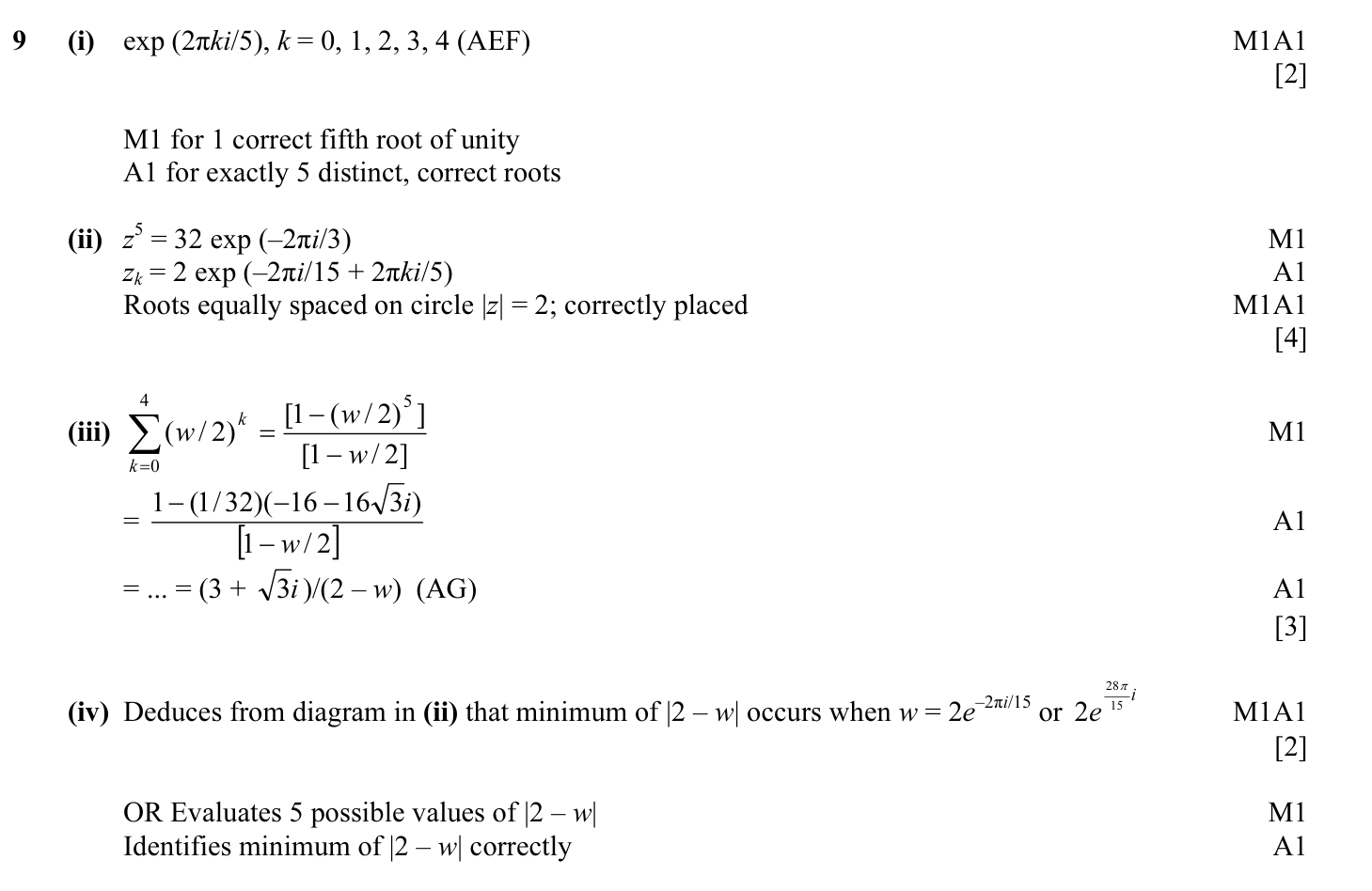
Answer: The fifth roots of unity are \(e^{2\pi ki/5}\), \(k=0,1,2,3,4\).
The roots of \(z^5+16+16\sqrt3\,i=0\) are
\(\displaystyle z=2e^{\,i\left(-\frac{2\pi}{15}+\frac{2\pi k}{5}\right)},\qquad k=0,1,2,3,4.\)
\(\displaystyle \sum_{k=0}^{4}\left(\frac w2\right)^k=\frac{3+i\sqrt3}{2-w}.\)
The root for which \(|2-w|\) is least is \(\displaystyle w=2e^{-2\pi i/15}\).
The fifth roots of unity are the solutions of \(z^5=1\):
\(z=e^{2\pi ki/5},\qquad k=0,1,2,3,4.\)
Now
\(z^5+16+16\sqrt3\,i=0\quad\Rightarrow\quad z^5=-16-16\sqrt3\,i.\)
Write the right-hand side in modulus-argument form:
\(-16-16\sqrt3\,i=32\left(-\frac12-\frac{\sqrt3}{2}i\right)=32e^{-2\pi i/3}.\)
So
\(z^5=32e^{-2\pi i/3}.\)
If \(z=re^{i\theta}\), then
\(r^5=32,\qquad 5\theta=-\frac{2\pi}{3}+2\pi k.\)
Therefore
\(r=2,\qquad \theta=-\frac{2\pi}{15}+\frac{2\pi k}{5}.\)
Hence
\(z=2e^{\,i\left(-\frac{2\pi}{15}+\frac{2\pi k}{5}\right)},\qquad k=0,1,2,3,4.\)
These roots lie equally spaced on the circle \(|z|=2\) in the Argand diagram.
Now let \(w\) be one of these roots. Then \(w^5=-16-16\sqrt3\,i\). Using the geometric series formula,
\(\sum_{k=0}^{4}\left(\frac w2\right)^k=\frac{1-(w/2)^5}{1-w/2}.\)
Since
\((w/2)^5=\frac{w^5}{32}=\frac{-16-16\sqrt3\,i}{32}=-\frac12-\frac{\sqrt3}{2}i,\)
we have
\(1-(w/2)^5=1+\frac12+\frac{\sqrt3}{2}i=\frac{3+i\sqrt3}{2}.\)
Also
\(1-\frac w2=\frac{2-w}{2}.\)
Therefore
\(\sum_{k=0}^{4}\left(\frac w2\right)^k=\frac{(3+i\sqrt3)/2}{(2-w)/2}=\frac{3+i\sqrt3}{2-w}.\)
Finally, \(|2-w|\) is the distance from the point \(2\) on the real axis to the root \(w\). On the diagram, the closest root is the one with argument nearest to \(0\), namely
\(w=2e^{-2\pi i/15}.\)