9231 P11 - Jun 2010 - Q3 - 7 marks
6524
At any point \((x, y)\) on the curve \(C\),
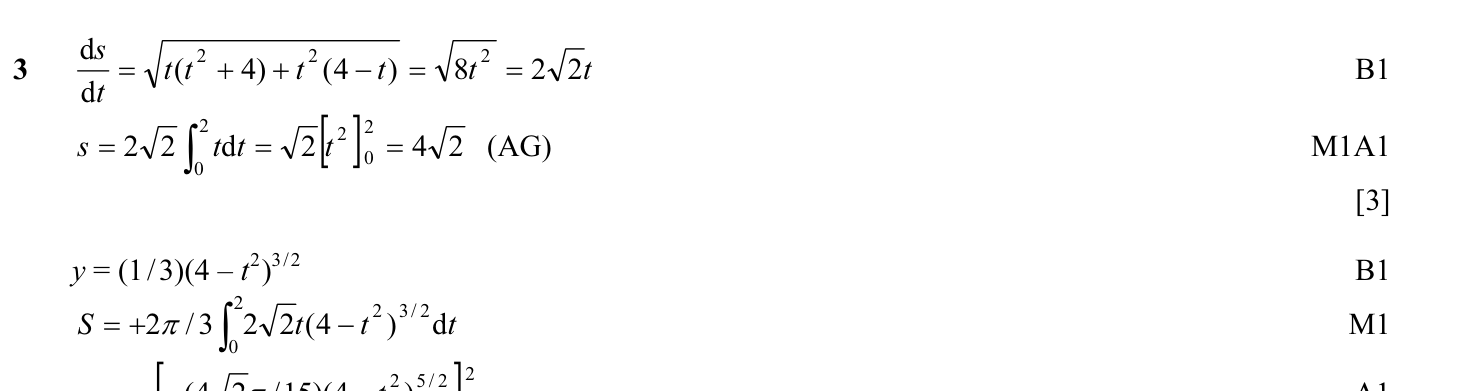
\(\frac{\mathrm{d} x}{\mathrm{~d} t}=t \sqrt{ }\left(t^{2}+4\right) \quad \text { and } \quad \frac{\mathrm{d} y}{\mathrm{~d} t}=-t \sqrt{ }\left(4-t^{2}\right)\)
where the parameter \(t\) is such that \(0 \leqslant t \leqslant 2\). Show that the length of \(C\) is \(4 \sqrt{ } 2\).
Given that \(y=0\) when \(t=2\), determine the area of the surface generated when \(C\) is rotated through one complete revolution about the \(x\)-axis, leaving your answer in an exact form.