Answer: Either
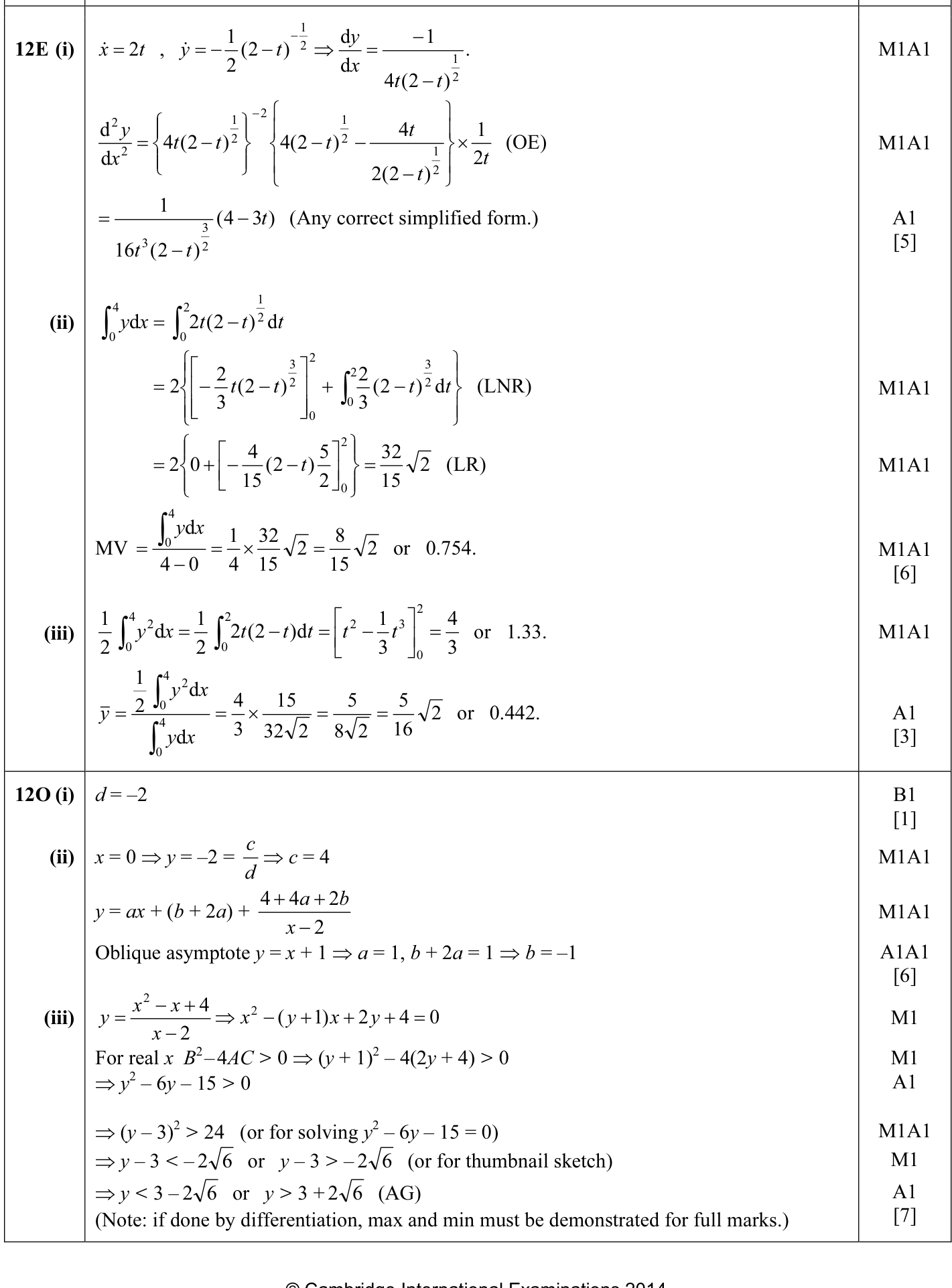
(i) \(\displaystyle \frac{\mathrm d^2y}{\mathrm dx^2}=\frac{4-3t}{16t^3(2-t)^{3/2}}\).
(ii) The mean value of \(y\) is \(\displaystyle \frac{8\sqrt2}{15}\).
(iii) The \(y\)-coordinate of the centroid is \(\displaystyle \frac{5\sqrt2}{16}\).
Or
\(d=-2,\quad a=1,\quad b=-1,\quad c=4\), and at all points on \(C\), \(\displaystyle y\leqslant 3-2\sqrt6\) or \(\displaystyle y\geqslant 3+2\sqrt6\).
Either
Here \(x=t^2\) and \(y=(2-t)^{1/2}\). First
\(\frac{\mathrm dx}{\mathrm dt}=2t,\qquad \frac{\mathrm dy}{\mathrm dt}=-\frac12(2-t)^{-1/2}.\)
Thus
\(\frac{\mathrm dy}{\mathrm dx}=\frac{\mathrm dy/\mathrm dt}{\mathrm dx/\mathrm dt}=-\frac{1}{4t(2-t)^{1/2}}.\)
Differentiate this with respect to \(t\), then divide by \(\dfrac{\mathrm dx}{\mathrm dt}=2t\):
\(\frac{\mathrm d^2y}{\mathrm dx^2}=\frac{\mathrm d}{\mathrm dt}\left(-\frac{1}{4t(2-t)^{1/2}}\right)\div 2t=\frac{4-3t}{16t^3(2-t)^{3/2}}.\)
For the mean value,
\(\text{mean}=\frac{1}{4}\int_0^4 y\,\mathrm dx.\)
Since \(x=t^2\), \(\mathrm dx=2t\,\mathrm dt\), and \(0\leq x\leq4\) corresponds to \(0\leq t\leq2\). Hence
\(\int_0^4 y\,\mathrm dx=\int_0^2 2t(2-t)^{1/2}\,\mathrm dt=\frac{32\sqrt2}{15}.\)
So
\(\text{mean}=\frac14\cdot\frac{32\sqrt2}{15}=\frac{8\sqrt2}{15}.\)
For the centroid,
\(\bar y=\frac{\frac12\int_0^4 y^2\,\mathrm dx}{\int_0^4 y\,\mathrm dx}.\)
Now \(y^2=2-t\), so
\(\frac12\int_0^4 y^2\,\mathrm dx=\frac12\int_0^2(2-t)\,2t\,\mathrm dt=\int_0^2t(2-t)\,\mathrm dt=\frac43.\)
Therefore
\(\bar y=\frac{4/3}{32\sqrt2/15}=\frac{5\sqrt2}{16}.\)
Or
The vertical asymptote is \(x=2\). Since the denominator is \(x+d\), \(2+d=0\), so
\(d=-2.\)
Thus
\(y=\frac{ax^2+bx+c}{x-2}.\)
The curve cuts the \(y\)-axis at \((0,-2)\), so
\(-2=\frac{c}{-2},\qquad c=4.\)
Dividing \(ax^2+bx+4\) by \(x-2\) gives
\(\frac{ax^2+bx+4}{x-2}=ax+(b+2a)+\frac{4+4a+2b}{x-2}.\)
The oblique asymptote is \(y=x+1\), so \(a=1\) and \(b+2a=1\). Therefore \(b=-1\).
Now
\(y=\frac{x^2-x+4}{x-2}.\)
Rearrange this as a quadratic in \(x\):
\(y(x-2)=x^2-x+4,\)
\(x^2-(y+1)x+2y+4=0.\)
For real points on the curve, this quadratic must have non-negative discriminant:
\((y+1)^2-4(2y+4)\geq0.\)
Thus
\(y^2-6y-15\geq0,\qquad (y-3)^2\geq24.\)
Hence
\(y\leqslant 3-2\sqrt6\quad\text{or}\quad y\geqslant 3+2\sqrt6.\)