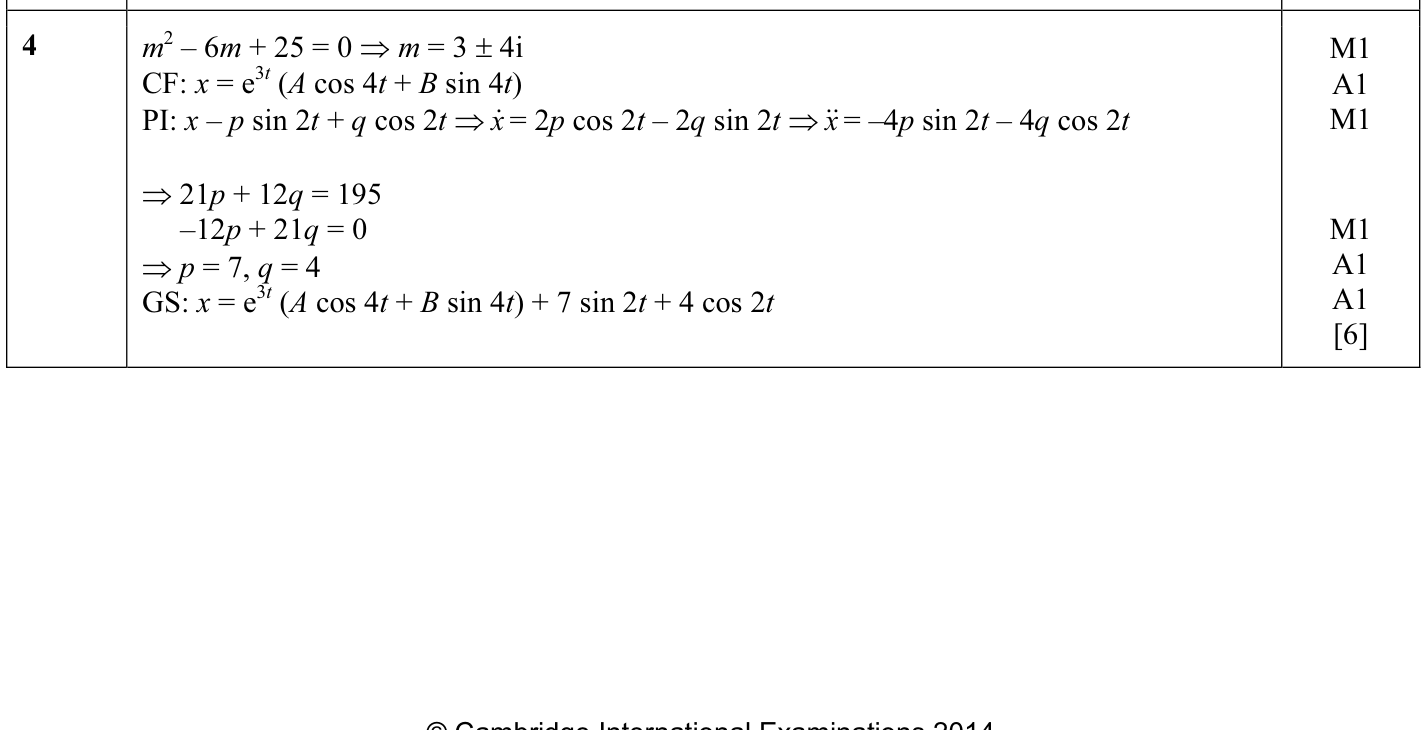
Answer: The general solution is \(x=e^{3t}(A\cos 4t+B\sin 4t)+7\sin 2t+4\cos 2t\).
We solve the complementary function first.
For \(\frac{\mathrm d^2 x}{\mathrm d t^2}-6\frac{\mathrm d x}{\mathrm d t}+25x=0\), the auxiliary equation is \(m^2-6m+25=0\).
So \(m=\frac{6\pm\sqrt{36-100}}{2}=3\pm 4i\).
Hence the complementary function is \(x_c=e^{3t}(A\cos 4t+B\sin 4t)\).
Now choose a particular integral of the form \(x_p=p\sin 2t+q\cos 2t\).
Then
\(\frac{\mathrm d x_p}{\mathrm d t}=2p\cos 2t-2q\sin 2t\),
and
\(\frac{\mathrm d^2 x_p}{\mathrm d t^2}=-4p\sin 2t-4q\cos 2t\).
Substitute into the differential equation:
\((-4p\sin 2t-4q\cos 2t)-6(2p\cos 2t-2q\sin 2t)+25(p\sin 2t+q\cos 2t)=195\sin 2t.\)
Collecting coefficients of \(\sin 2t\) and \(\cos 2t\) gives
\(21p+12q=195,\qquad -12p+21q=0.\)
From \(-12p+21q=0\), we have \(4p=7q\), so \(p=\frac{7}{4}q\). Substituting into the first equation:
\(21\left(\frac{7}{4}q\right)+12q=195\)
\(\frac{147}{4}q+\frac{48}{4}q=195\)
\(\frac{195}{4}q=195\)
so \(q=4\), and therefore \(p=7\).
Thus \(x_p=7\sin 2t+4\cos 2t\).
So the general solution is \(x=e^{3t}(A\cos 4t+B\sin 4t)+7\sin 2t+4\cos 2t\).