9231 P13 - Jun 2012 - Q11 - 28 marks
Answer only one of the following two alternatives.
EITHER
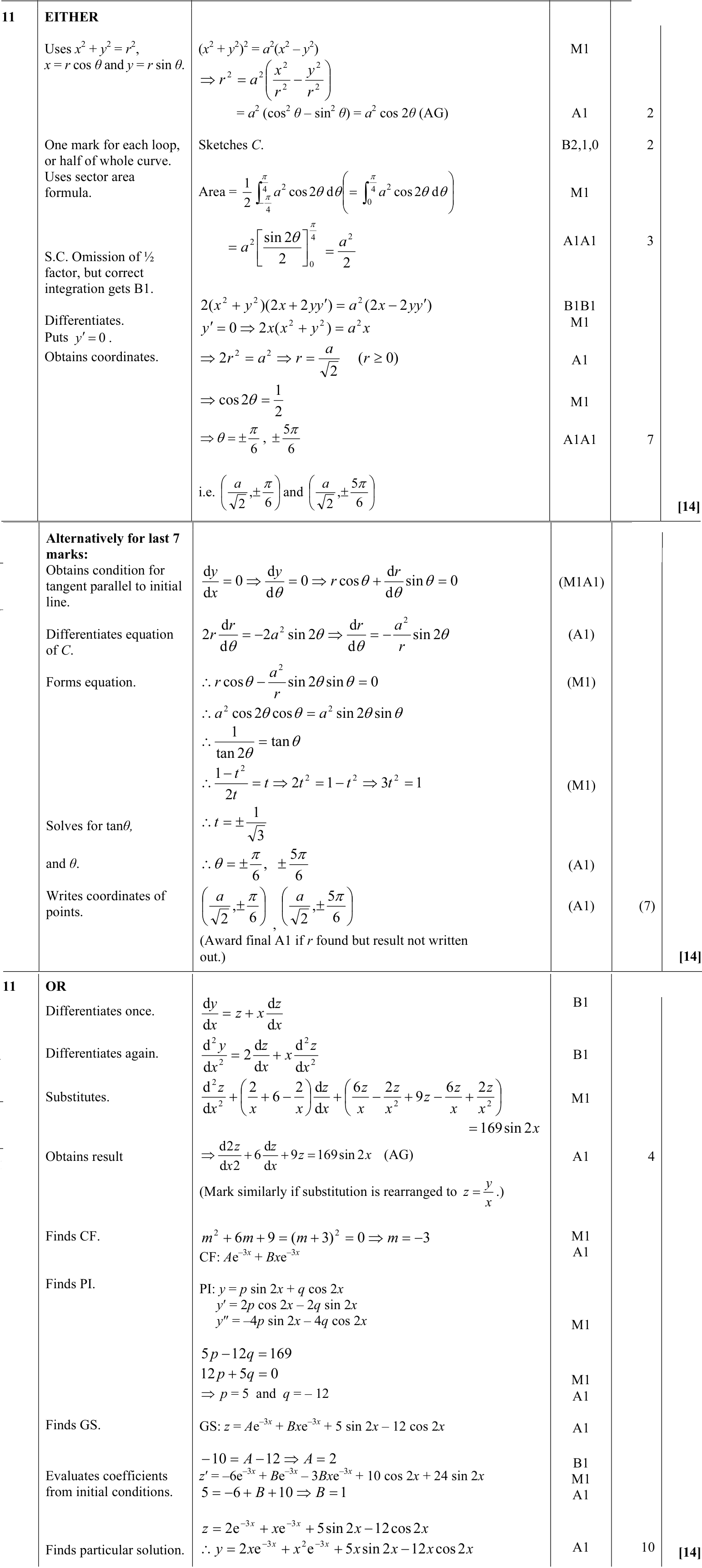
The curve \(C\) has cartesian equation
\(\left(x^{2}+y^{2}\right)^{2}=a^{2}\left(x^{2}-y^{2}\right),\)
where \(a\) is a positive constant. Show that \(C\) has polar equation
\(r^{2}=a^{2} \cos 2 \theta .\)
Sketch \(C\) for \(-\pi\lt \theta \leqslant \pi\).
Find the area of the sector between \(\theta=-\frac{1}{4} \pi\) and \(\theta=\frac{1}{4} \pi\).
Find the polar coordinates of all points of \(C\) where the tangent is parallel to the initial line.
OR
Show that the substitution \(y=x z\) reduces the differential equation
\(\frac{1}{x} \frac{\mathrm{~d}^{2} y}{\mathrm{~d} x^{2}}+\left(\frac{6}{x}-\frac{2}{x^{2}}\right) \frac{\mathrm{d} y}{\mathrm{~d} x}+\left(\frac{9}{x}-\frac{6}{x^{2}}+\frac{2}{x^{3}}\right) y=169 \sin 2 x\)
to the differential equation
\(\frac{\mathrm{d}^{2} z}{\mathrm{~d} x^{2}}+6 \frac{\mathrm{~d} z}{\mathrm{~d} x}+9 z=169 \sin 2 x .\)
Find the particular solution for \(y\) in terms of \(x\), given that when \(x=0, z=-10\) and \(\frac{\mathrm{d} z}{\mathrm{~d} x}=5\).