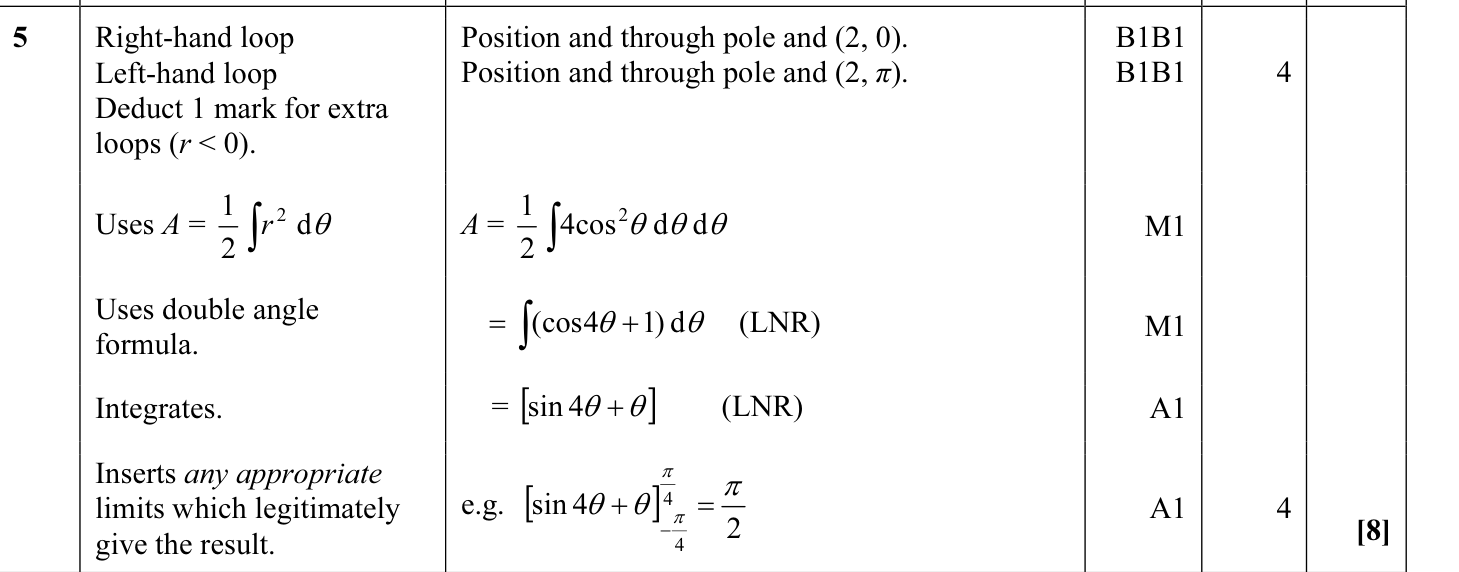
Answer: The curve is a four-petalled rose. Since \(r=2\cos 2\theta\), it has a loop on the positive \(x\)-axis, with one tip at \((2,0)\). By symmetry, the other loops lie on the negative \(x\)-axis and the \(y\)-axis.
The exact area of one loop is \(\frac{\pi}{2}\).
For \(r=2\cos 2\theta\), the graph is a rose curve with four equal loops.
To sketch one loop, note that when \(\theta=0\), \(r=2\), so the curve passes through \((2,0)\). Also, when \(r=0\), we have \(\cos 2\theta=0\), so \(2\theta=\frac{\pi}{2}\) or \(\frac{3\pi}{2}\), giving \(\theta=\frac{\pi}{4}\) or \(\frac{3\pi}{4}\). Thus the right-hand loop is traced for \(-\frac{\pi}{4}\le \theta \le \frac{\pi}{4}\), starting and ending at the pole.
To find the area of one loop, use the polar area formula
\(A=\frac{1}{2}\int r^2\,d\theta\).
For the right-hand loop,
\(A=\frac{1}{2}\int_{-\pi/4}^{\pi/4} (2\cos 2\theta)^2\,d\theta=2\int_{-\pi/4}^{\pi/4}\cos^2 2\theta\,d\theta\).
Use \(\cos^2 x=\frac{1+\cos 2x}{2}\):
\(A=2\int_{-\pi/4}^{\pi/4}\frac{1+\cos 4\theta}{2}\,d\theta=\int_{-\pi/4}^{\pi/4}(1+\cos 4\theta)\,d\theta\).
So
\(A=[\theta+\tfrac{1}{4}\sin 4\theta]_{-\pi/4}^{\pi/4}\).
Now \(\sin(\pi)=\sin(-\pi)=0\), hence
\(A=\left(\frac{\pi}{4}-\left(-\frac{\pi}{4}\right)\right)=\frac{\pi}{2}\).