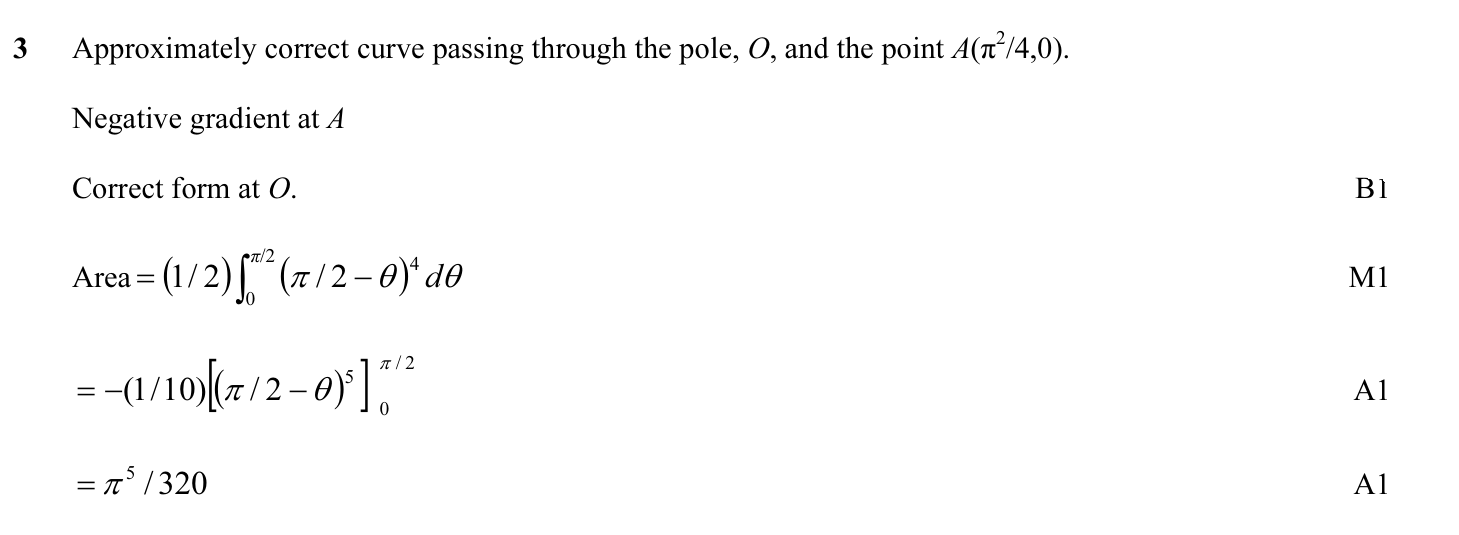
Answer: The curve starts at the pole when \(\theta=\frac{\pi}{2}\), since then \(r=0\). When \(\theta=0\), \(r=\left(\frac{\pi}{2}\right)^2=\frac{\pi^2}{4}\), so it passes through the point \(\left(\frac{\pi^2}{4},0\right)\) on the initial line.
The curve is given by \(r=\left(\frac{\pi}{2}-\theta\right)^2\), so as \(\theta\) increases from \(0\) to \(\frac{\pi}{2}\), \(r\) decreases smoothly to \(0\). A suitable sketch is a curve in the first quadrant joining \(\left(\frac{\pi^2}{4},0\right)\) to the pole, with the curve meeting the initial line at \(\left(\frac{\pi^2}{4},0\right)\) and arriving at the pole with a negative gradient there.
The required area is \(\frac{\pi^5}{320}\).
For a polar curve, the area enclosed between \(\theta=a\) and \(\theta=b\) is
\(\displaystyle A=\frac12\int_a^b r^2\,d\theta\).
Here \(r=\left(\frac{\pi}{2}-\theta\right)^2\) for \(0\le \theta\le \frac{\pi}{2}\), so
\(\displaystyle A=\frac12\int_0^{\pi/2}\left(\frac{\pi}{2}-\theta\right)^4\,d\theta\).
Let \(u=\frac{\pi}{2}-\theta\). Then \(du=-d\theta\). When \(\theta=0\), \(u=\frac{\pi}{2}\); when \(\theta=\frac{\pi}{2}\), \(u=0\). Hence
\(\displaystyle A=\frac12\int_{\pi/2}^{0}u^4(-du)=\frac12\int_0^{\pi/2}u^4\,du\).
So
\(\displaystyle A=\frac12\left[\frac{u^5}{5}\right]_0^{\pi/2}=\frac{1}{10}\left(\frac{\pi}{2}\right)^5=\frac{\pi^5}{320}.\)
Therefore the area bounded by \(C\) and the initial line is \(\boxed{\frac{\pi^5}{320}}\).