Answer:
Final results:
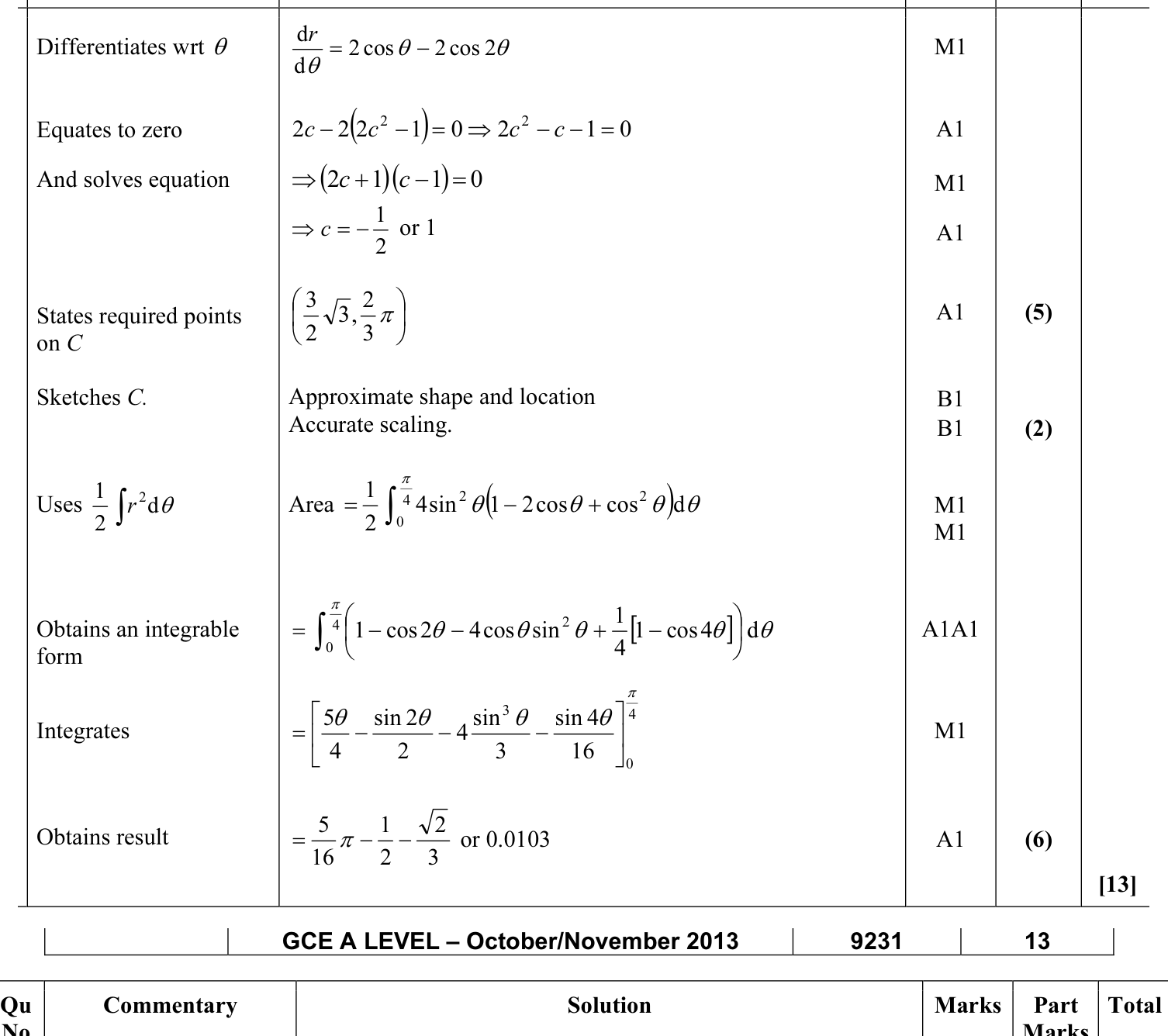
\(\dfrac{\mathrm{d}r}{\mathrm{d}\theta}=2\cos\theta-2\cos 2\theta\).
The point furthest from the pole occurs when \(\cos\theta=-\tfrac12\), so \(\theta=\tfrac{2\pi}{3}\). Then \(r=\dfrac{3\sqrt3}{2}\). Hence the point is \(\left(\dfrac{3\sqrt3}{2},\dfrac{2\pi}{3}\right)\).
The exact area of the sector from \(\theta=0\) to \(\theta=\tfrac\pi4\) is \(\dfrac{5\pi}{16}-\dfrac12-\dfrac{\sqrt2}{3}\).
We have \(r=2\sin\theta(1-\cos\theta)\) for \(0\leqslant\theta\leqslant\pi\).
Differentiate \(r\) with respect to \(\theta\)
Using the product rule,
\(\dfrac{\mathrm{d}r}{\mathrm{d}\theta}=2\cos\theta(1-\cos\theta)+2\sin\theta(\sin\theta)\).
Simplifying,
\(\dfrac{\mathrm{d}r}{\mathrm{d}\theta}=2\cos\theta-2\cos^2\theta+2\sin^2\theta=2\cos\theta-2(\cos^2\theta-\sin^2\theta)=2\cos\theta-2\cos 2\theta\).
So
\(\dfrac{\mathrm{d}r}{\mathrm{d}\theta}=2\cos\theta-2\cos 2\theta\).
Point furthest from the pole
At the furthest point, \(r\) is stationary, so set \(\dfrac{\mathrm{d}r}{\mathrm{d}\theta}=0\):
\(2\cos\theta-2\cos 2\theta=0\).
Let \(c=\cos\theta\). Since \(\cos 2\theta=2c^2-1\),
\(2c-2(2c^2-1)=0\).
So
\(2c^2-c-1=0\).
Factorising gives
\((2c+1)(c-1)=0\),
hence \(c=-\tfrac12\) or \(c=1\).
Now \(c=1\) gives \(\theta=0\), where \(r=0\), so this is the pole and not the furthest point. Therefore take
\(\cos\theta=-\tfrac12\implies \theta=\tfrac{2\pi}{3}\)
since \(0\leqslant\theta\leqslant\pi\).
Then
\(r=2\sin\left(\tfrac{2\pi}{3}\right)\left(1-\cos\left(\tfrac{2\pi}{3}\right)\right)\)
\(=2\cdot \tfrac{\sqrt3}{2}\left(1-\left(-\tfrac12\right)\right)=\sqrt3\cdot \tfrac32=\tfrac{3\sqrt3}{2}\).
So the point furthest from the pole is \(\left(\tfrac{3\sqrt3}{2},\tfrac{2\pi}{3}\right)\).
Sketch of \(C\)
The curve starts at the pole when \(\theta=0\), since \(r=0\). It remains with \(r\geqslant 0\) for \(0\leqslant\theta\leqslant\pi\), and returns to the pole at \(\theta=\pi\) because \(\sin\pi=0\). The maximum radius is \(\tfrac{3\sqrt3}{2}\) at \(\theta=\tfrac{2\pi}{3}\). So the curve is a single loop lying above the polar axis, bulging out most strongly near \(\theta=\tfrac{2\pi}{3}\), then returning to the pole at \(\theta=\pi\).
Exact area of the sector from \(\theta=0\) to \(\theta=\tfrac\pi4\)
For a polar sector,
\(A=\dfrac12\int r^2\,\mathrm{d}\theta\).
Here
\(r^2=4\sin^2\theta(1-\cos\theta)^2=4\sin^2\theta(1-2\cos\theta+\cos^2\theta)\).
Hence
\(A=\dfrac12\int_0^{\pi/4}4\sin^2\theta(1-2\cos\theta+\cos^2\theta)\,\mathrm{d}\theta\).
Now expand and rewrite using standard identities:
\(A=\int_0^{\pi/4}\left(1-\cos 2\theta-4\cos\theta\sin^2\theta+\tfrac14(1-\cos 4\theta)\right)\,\mathrm{d}\theta\).
Integrating term by term gives
\(A=\left[\tfrac{5\theta}{4}-\tfrac12\sin 2\theta-\dfrac{4}{3}\sin^3\theta-\dfrac{1}{16}\sin 4\theta\right]_0^{\pi/4}\).
Substitute \(\theta=\tfrac\pi4\): \(\sin\tfrac\pi2=1\), \(\sin\tfrac\pi4=\tfrac{\sqrt2}{2}\), and \(\sin\pi=0\). This gives
\(A=\dfrac{5\pi}{16}-\dfrac12-\dfrac{\sqrt2}{3}\).